8 Ways To Get To Gasparilla 2015 Pirate Festival

7 Ways To Avoid A DUI at Gasparilla Pirate Festival 2015

Gasparilla Pirate Festival Ship 2015

As of 2023 and historically, there were 42 Gasparilla Pirate Festival related arrests and 63 open container civil citations (No open containers of alcohol outside the “wet-zone” or the parade route). Do not end your party in jail! With just a little fore thought you here are 8 ways to get to Gasparilla 2015 and avoid a DUI or BUI this weekend:

Gasparilla Pirate Festival Travel Plans


1. Charter A Helicopter.

        oldcityhelicopters.com charters helicopters from Davis Island (813) 254-1300

2. Charter A Yacht.

          suncoastadventurecenter.com charter a yacht and crew  (727) 480-8289

3. Take A Bus Or Streetcar

          Hillsborough Area Regional Transit  will be running extra buses. Park and ride the bus both ways for only $4. (813) 254-HART or (813) 254-4278

4. Take A Taxi

          Suburban Taxi (727) 260 8294
          Go Taxi Florida (727) 386-6787
          Metro Taxi (727) 412-2101
          Yellow Cab (813) 253-0121
          Cab Plus (813) 288-8888
          United Cab (813) 251-5555
          TampaWaterTaxiCo.com for a little twist try a water taxi (813) 900-3288

5. Designate A Driver: A Friend Or A Service For Hire.

          You or a friend agree not to drink and be the designated driver for the day.
          ZingoTampa.com You drive yourself there and hire someone to come and drive your car home. (888) ZIN-GO 11 or (888) 946-4611
          DesignatedTampa.com  You drive yourself there and hire someone to come and drive your car home. (813) 444-2332

6. Get A Car Ride From A Friend Or Pay For A Car Ride.

          Ride in a friend’s car with your friend who will not be drinking.
          Uber.com download application onto your phone then arrange for a pickup.
          Lyft.com download application onto your phone then arrange for a pickup.

7. Get A Hotel Near The Route And Sleep It Off.

Hyde Park Hotel 2105 West Bristol Avenue, Tampa, FL 33606 (813) 254-2000
Epicurean Hotel Autograph Collection 1207 South Howard Avenue Tampa, FL 33606 (813) 999-8700
Embassy Suites® Tampa – Hilton.com‎ 513 South Florida Avenue, Tampa, FL 33602 (813) 769-8300
Tampa Marriott Waterside Hotel & Marina 700 South Florida Avenue, Tampa, FL 33602 (813) 221-4900
The Westin Tampa Harbour Island 725 South Harbour Island Boulevard, Tampa, FL 33602 (813) 229-5000
Hilton Tampa Downtown 211 North Tampa Street, Tampa, FL 33602 (813) 204-3000
Sheraton Tampa Riverwalk Hotel 200 North Ashley Drive, Tampa, FL 33602 (813) 223-2222

8. As A Last Resort Call AAA

          AAAs TOW2GO at (855) TOW2GO (855) 286-9246
Mention of third party companies and products is for informational purposes only and constitutes neither an endorsement nor a recommendation.

Read Our Past Gasparilla Pirate Festival Posts:

Mr. Casey Ebsary, Tampa Criminal Defense Lawyer, found this Tampa Police Video. Casey Ebsary (813-222-2220) is working this weekend helping people charged at this year’s Gasparilla in Tampa.

16 Tips For Surviving Gasparilla Piratefest Invasion

Believe it or not, it is possible to enjoy the Gasparilla Pirate Invasion without waking up with a criminal record…Read More

https://www.dui2go.com/2013/01/surviving-gasparilla-pirate-invasion.html

Tampa Attorney BUI | Boating Under Influence | Gasparilla Arrest

In one recent Piratefest weekend there were 5 Gasparilla BUI Boating Under the Influence Arrests…Read More

https://www.dui2go.com/2011/01/tampa-bui-boating-under-influence.html

Boating Under the Influence – Crash Video

BUI charged Speedboat driver charged with manslaughter in fatal crash…Read More

https://www.dui2go.com/2013/07/boating-under-influence-crash-video.html

Gasparilla Notice to Appear or Arrest? Affordable Help From an Attorney | Lawyer | (813) 222-2220

In 2010 there were 5 BUI Boating Under the Influence Arrests. The Police, Sheriff’s Office, Coast Guard, and Florida Fish and Wildlife will be using a Mobile Facility this year to process arrests…Read More

https://www.drug2go.com/2011/01/gasparilla-notice-to-appear-or-arrest.html

Arrest Report Gasparilla Update

Tampa police reported 349 arrests, most for alcohol violations and all but three misdemeanors…Read More

https://www.drug2go.com/2011/01/arrest-report-gasparilla-update-359.html

Florida DUI Laws – Questions and Answers – Florida DUI Information

Under Florida DUI Laws, Can the Court eliminate a DUI suspension imposed by the Bureau of Administrative Reviews – The Florida Department of Highway Safety and Motor Vehicles – DHSMV?

Questions and Answers

Questions and Answers

Under Florida DUI laws / traffic laws sections 316.656 and 322.2615 trial judges in county or circuit courts cannot alter the administrative suspension and / or revocation periods. On an equally important note, courts are prohibited from withholding adjudication in DUI cases; or from reducing a DUI charge if the defendant’s blood alcohol was over .20 . The only way to have an impact on the ability to drive after a DUI traffic stop, an arrest for DUI, a refusal to submit to a chemical test, or a breath result above .08 is to immediately take advantage of the procedures available via the Department of Highway Safety and Motor Vehicles (DHSMV) Bureau of Administrative Reviews (BAR).

Why should I hire a DUI Lawyer?

When stopped and arrested for DUI you may need to set a court hearing. Sometimes the hearing dates are set automatically. One reason to hire a competent DUI attorney is to find out the benefits that may be gained by investigating possible defenses, the risks of conviction, and what sentence may be imposed. Sometimes prosecutors make specific offers, but it is tough for defendants to reach out and personally discuss the case without making statements that the State can use against the driver.

What would be the advantage of hiring a Criminal Defense Attorney?

Sometimes drivers consider contacting the Office of the State Attorney or the Prosecutor in their own DUI case. The defense attorney can help with the initial administrative license suspension that will occur, if not challenged, within 10 days of the traffic stop and arrest. The lawyer may be able to help get a driving permit for work or business purposes. This short time period (less than two-weeks) will come and go long before the police, the clerk of courts, the Judge and prosecuting authorities ever even open a case file and set a court date. That is why many people hire private lawyers to find out if an arrest was improper. If the right questions are asked during the defense attorney’s investigation, the lawyer may be able to get the case dismissed. A lawyer may be able to get a better plea arrangement, keep you on the road, and out of jail.

What is the Legal Limit under Florida DUI Law?

Since an arrest for DUI can be made if an officer thinks a driver’s normal faculties are impaired, there is no legal limit. In Florida, a person can be arrested and convicted of DUI after consuming any amount of alcohol, even if the results are below a .08. Sometimes drivers are arrested and submit to other chemical tests and the results will not be available for weeks after the arrest.

What does .08 mean under Florida DUI Laws?

What does .08 mean under Florida DUI Laws?

What does a .08 mean?

Frequently a .08 is referred to as the legal limit. In Florida this is not entirely accurate. Under Florida Law, .08 BAC is a presumptive level for impairment. In other words, if you reach a .08 BAC, you are automatically considered impaired and a jury will be told to presume you are impaired if all procedures have been followed using an accurate breath testing machine. The instructions given to jurors can be found here.

What if a Florida Driver is below .08 BAC?

A driver can still be convicted of DUI even if under .08 BAC. This seems unusual and it is. In Florida, if a Prosecutor can convince a Judge and Jury that driving ability was impaired, a conviction and virtually permanent entry on a driver ‘s record will follow.By the way, drivers are already under arrest before even given a breath test in Florida.

Florida DUI Adjudication and Sentencing

Under the DUI Laws in this state, and based upon the Florida Statutes sections 316.656 and 322.2615 a conviction or plea agreement to a driving under the influence charge results in an adjudication which is the legal term for conviction. Upon the closing of a DUI case as charged (without a reduced charge of reckless driving) drivers become convicted criminals and an entry is made on the official driver’s license record. The law states, “no court may suspend, defer, or withhold adjudication of guilt or imposition of sentence for any violation of s. 316.193 . . . .”

There are also minimum sentences including license suspension, fines, court costs and attendance at an approved alcohol traffic education course commonly referred to as the DUI School. The law provides, “If the suspension of the driver’s license of the person relating to unlawful blood-alcohol level or breath-alcohol level of 0.08 or higher is sustained, the person is not eligible to receive a license for business or employment purposes only pursuant to s. 322.271 until 30 days have elapsed after the expiration of the last temporary permit issued. ” Furthermore, “If the suspension of the driver’s license of the person for failure to submit to a breath, urine, or blood test is sustained, the person is not eligible to receive a license for business or employment purposes only, pursuant to s. 322.271, until 90 days have elapsed after the expiration of the last temporary permit issued.”

Stay Out of Jail Free Card – DUI Ride Service – DUI Lawyer

855-286-9246

A Free Ride For You or a Friend in Florida. Use this number 855-286-9246 to avoid a DUI and the need for a dui lawyer. Download the number to your phone, print it, and share it with all you friends and family. Keep it with you in case you end up in a tight spot. Tow to Go is a program of the Auto Club Group Traffic Safety Foundation. For full details visit

https://autoclubsouth.aaa.com/safety/tow_to_go.aspx .

DUI Take a Cab or a Tow Truck Call (855) 2-TOW-2-GO

Free Ride for 2 People
No Advance Reservations Allowed
Offer Valid Dec 24 to Jan 1

Recently the Florida Highway Patrol reported that 33.5 percent of fatalities in car crashes were alcohol related. There are programs designed to prevent folks who’ve had a little too much holiday cheer from getting behind the wheel are helping the statistics drop. The American Automobile Association AAA dispatches tow trucks to take tipsy car owners and their vehicles home, free of charge. The service allows bar and restaurant managers to use cabbies as designated drivers from 8 p.m. to 3 a.m. In one three year period, more than 2,500 drunken drivers have remained off the road.

The Florida Highway Patrol Preliminary Fatality Report revealed that there were 37 deaths in some 29 crashes over the Thanksgiving weekend, three of which were alcohol related. “Along with the combination of enforcement and education, the programs certainly do have an impact,” said Lt. David Folsom, who supervises TPD’s traffic unit. Both initiatives run through New Year’s Day.”

To Drive or not to Drive . . .

“The penalties for DUI in the state of Florida can cost as much as $5,000 on the first offense, according to local law-enforcement officials. Offenders face revoked licenses, criminal records, community service, increased insurance rates, probation, fines and possible imprisonment.Still, bar patrons say more leniency from the law and property owners is needed if they want them do the right thing and avoid driving home drunk.Still, the towing costs for a DUI are higher — financially and emotionally — than for requesting a tow, Overstreet said.”They can look at it as they are still getting screwed, but when you compare the cost of a DUI arrest, that’s pretty cheap,” he said. “It’s much worse if you get in an accident and hurt or kill somebody. You’re looking at spending the next 15 years in prison.”

No Phone Zone – Jurors Must Log Off Says Florida Court


jurors, Cell Phone, iPhone, computer, cell phones, smartphones, tablets, laptops, computers, electronic devices

Jurors and Cell Phones

No Phone Zone for Jurors

“electronic devices will be removed from all members of a jury panel before jury deliberations begin”


Jurors and Cell Phones


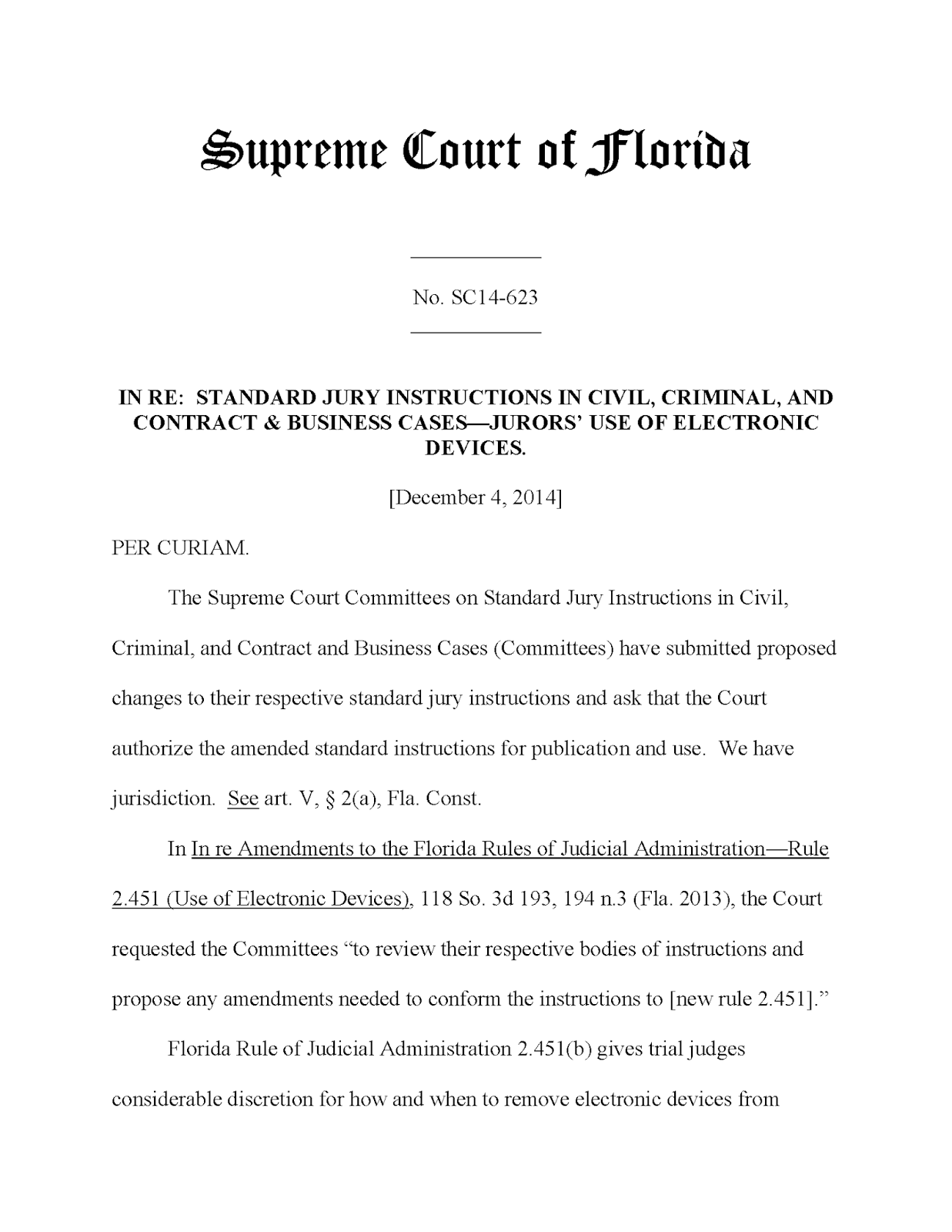
In a mere 43 pages, the Florida Supreme Court has told judges, civil, and criminal defense lawyers how to address widespread use of electronic devices by jurors in courts. We now have guidance on what is meant by turning off these devices. There are very specific instructions to be given during trials. The instructions now tell jurors what to do with computers, tablets, and cell phones during breaks and recesses. Jurors also receive an explanation of why they are to be disconnected with the outside world during jury service.
 

What has Florida told lawyers and Judges about use of electronics by Jurors?


“The rule provides that electronic devices will be removed from all members of a jury panel before jury deliberations begin.  The presiding judge may remove the jurors’ electronic devices at other stages of the trial.  If electronic devices are removed from members of the jury panel during trial, the judge may order them returned during recesses.  If a jury panel is sequestered, the judge may decide whether to remove electronic devices during the entire period of sequestration.  The rule also makes clear that during court proceedings, jurors cannot use their electronic devices to take photos or videos, or to transmit or access data or text.  At all times, jurors are prohibited from using the devices to research information about the case or to communicate with others about the case or jury deliberations.”

What does the Court mean when Jurors are told to turn off electronic devices?


“All cell phones, computers, tablets or other types of electronic devices must be turned off while you are in the courtroom. Turned off means that the phone or other electronic device is actually off and not in a silent or vibrating mode.”

What are Jurors told about use of electronics in Court?


“Many of you have electronic devices such as cell phones, smartphones, tablets, and laptops, computers, and other electronic devices.  Even though you have not yet been selected as a juror, there are some strict rules that you must follow about using your cell phones, electronic devices and computers.”
“When you are called to a courtroom, the judge will give you specific instructions on the use of electronic devices.  These rules are so important that the judge may tell you that you must turn off your cell phone or other electronic devices completely or that you cannot have your cell phone or electronic devices in the courtroom.  If someone needs to contact you in case of an emergency, the judge will provide you with a phone number where you can receive messages.”
“If the trial judge allows you to keep your cell phones, computers, or other electronic devices, you cannot use them to take photographs, video recordings, or audio recordings of the proceedings in the courtroom or your fellow jurors.  You must not use the many device to search the Internet or to find out anything related to any cases in the courthouse.”

Why are Jurors told to log off of cell phones, smartphones, tablets, and laptops, computers, and other electronic devices.?


“Why is this restriction imposed?  This restriction is imposed because jurors must decide the case without distraction and only on the evidence presented in the courtroom.  I know that, for some of you, these restrictions affect your normal daily activities and may require a change in the way you are used to communicating and perhaps even in the way you are used to learning.”
“If you investigate, research, or make inquiries on your own, the trial judge has no way to make sure that the information you obtain is proper for the case.  The parties likewise have no opportunity to dispute or challenge the accuracy of what you find.  Any independent investigation by a juror unfairly and improperly prevents the parties from having that opportunity our judicial system promises.”
“Between now and when you have been discharged from jury duty by the judge, you must not provide or receive / discuss any information about your jury service to / with anyone, including friends, co-workers, and family members. You may tell those who need to know where you are that you have been called for jury duty. If you are picked for a jury, you may tell people that you have been picked for a jury and how long the case may take. However, you must not give anyone any information about the case itself or the people involved in the case. You must also warn people not to try to say anything to you or write to you about your jury service or the case. This includes face-to-face, phone or computer communications.”
“In this age of electronic communication,I want to stress that you must not use electronic devices or computers to talk about this case, including tweeting, texting, blogging, e-mailing, posting information on a website or chat room, or any other means at all.  Do not send or accept any messages, including e-mail and text messages, about your jury service. You must not disclose your thoughts about your jury service or ask for advice on how to decide any case.”
“After you are called to the courtroom, the judge will give you specific instructions about these matters.  The / A judge will tell you when you are released from this instruction.  Remember, these rules are designed to guarantee a fair trial.  It is important that you understand the rules as well as the impact on our system of justice if you fail to follow them.  If it is determined that any one of you has violated this rule, and conducted any type of independent research or investigation, it may result in a mistrial.  A mistrial would require the case to be tried again at great expense to the parties and the judicial system. The judge may also impose a penalty upon any juror who violates this instruction.  All of us are depending on you to follow these rules, so that there will be a fair and lawful resolution of every case. “

What happens with electronics when jurors take a break or recess?


“We are about to take [our first] [a] recess. Remember that all of the rules I have given you apply even when you are outside the courtroom, such as at recess. “
“Remember the basic rule:  Do not talk to anyone, including your fellow jurors, friends, family or co-workers about anything having to do with this trial, except to speak to court staff.  This means no e-mailing, text messaging, tweeting, blogging, or any other form of communication.”
“You cannot do any research about the case or look up any information about the case.  Remember to observe during our recess the other rules I gave you. If you become aware of any violation of any of these rules at all, notify court personnel of the violation.”
“After each recess, please double check to make sure [that your cell phone or other electronic device is turned off completely] [that you do not bring your cell phone or other electronic device into the courtroom or jury room].”
Cell Phone, cell phones, computer, computers, electronic devices, iPhone, jurors, laptops, smartphones, tablets,

Jury Instructions on Cell Phones and Electronic Devices

Read the Complete Criminal and Civil Instruction for Jurors and Cell Phones Here

Wiretaps in Federal Prosecutions | Florida

Wiretaps - An Overview of Federal Statutes Governing Wiretapping and Electronic Eavesdropping

Wiretaps

Wiretaps in Federal Prosecutions

A friend at the Federal Defender’s Office in Florida just sent us this information on Wiretaps in Federal Prosecution and  provided us with a new Congressional Research Service report entitled “Privacy: An Overview of Federal Statutes Governing Wiretapping and Electronic Eavesdropping.” It is comprehensive and should be useful to anyone with a case in which wiretaps are an issue. Some excerpts are below and a download of the complete document is available below.:


“Unless otherwise provided, Title III/ECPA outlaws wiretapping and electronic eavesdropping; possession of wiretapping or electronic eavesdropping equipment; use or disclosure of information obtained through illegal wiretapping or electronic eavesdropping; and disclosure of information secured through court-ordered wiretapping or electronic eavesdropping, in order to obstruct justice, 18 U.S.C. 2511. Elsewhere, federal law proscribes:
  • unlawful access to stored communications, 18 U.S.C. 2701;
  • unlawful use of a pen register or a trap and trace device, 18 U.S.C. 3121; and
  • abuse of eavesdropping and search authority or unlawful disclosures under the Foreign Intelligence Surveillance Act, 50 U.S.C. 1809, 1827.”

The report summarizes:

“At the heart of Title III/ECPA lies the prohibition against illegal wiretapping and electronic eavesdropping, 18 U.S.C. 2511(1), that bans:

  • any person from
  • intentionally
  • intercepting, or endeavoring to intercept,
  • wire, oral or electronic communications
  • by using an electronic, mechanical or other device
  • unless the conduct is specifically authorized or expressly not covered, e.g. one of the parties to the conversation has consent to the interception
  • the interception occurs in compliance with a statutorily authorized, (and ordinarily judicially supervised) law enforcement or foreign intelligence gathering interception,
  • the interception occurs as part of providing or regulating communication services,
  • certain radio broadcasts, and in some places, spousal wiretappers.”

The complete report is available here,

The Web Mob a/k/a La Cosa Webstra

Cybercrime: A Lucrative and Dangerous Underground World

The underground world of cybercrime is thriving, with millions of stolen credit card numbers and personal identification details available for mere dollars. This report delves into the activities of digital mobsters who specialize in phishing expeditions, sending millions of scam emails daily. These cybercriminals remain hidden behind digital aliases, screen names, and encrypted communication channels, engaging in various illicit activities.

Virtual Hit Men: Anonymity and Retribution

One significant incident involved the theft of 150,000 consumer records, credit reports, and Social Security numbers by cybercriminals. These individuals operate as a digital gang, punishing errant members by exposing their true identities on public websites, effectively assassinating their virtual personas. The Secret Service has recently made a major breakthrough, arresting 28 individuals, indicting 19, and uncovering a network of 4,000 web-based mob members.

Web Mob Busted: Coordinated Law Enforcement Action

Law enforcement agencies took synchronized action against this cyber mob, conducting raids on multiple gang members simultaneously while they were engaged in web-based discussions. By capturing key figures and taking control of the gang’s website, they issued warnings to potential suspects. This operation significantly disrupted the criminal network’s activities.

Bottom Line: A Dark Marketplace

The cybercriminal marketplace operates discreetly, with stolen credit card data, worth thousands of dollars, being sold for as little as $1 to $10. Personal identification information, including email addresses, is even cheaper. The culprits range from high school dropouts to IT postgraduates, all exploiting the perceived anonymity of the internet to profit from confidential data on the world’s computer networks.

Authors: W.F. “Casey” Ebsary, Jr., CentralLaw.com and Albert Lucas, B.A. Mathematics

Full Text of Article:

Millions of stolen credit card numbers and other personal identification information are available for less than ten dollars according to experts at Baseline magazine and the United States Department of Justice. Unlike Michael Corleone’s crew, these mobsters exist solely in cyberspace. Phishing expeditions are their forte, with estimates of between 75 and 150 million scam emails sent daily.

Virtual Hit Men

Recently one large data collector was hit by mobsters who stole or accessed nearly 150,000 consumer records, credit reports, and Social Security numbers. This gang hides behind digital aliases, screen names, and nicknames. To punish wayward gang members, enforcers will publish the true names and identifying information of formerly anonymous transgressors on websites. Supplying the rat’s true identity to law enforcement virtually assassinates the individual in cyberspace.

The Secret Service recently tracked down one such gang. With 28 arrests, 19 indictments, and 4,000 gang members, the Government has penetrated one of the largest, if not the largest known web mob. Again, unlike secret meetings of the heads of the families, the web mobs met in web based discussion forums where they discussed and attempted to perfect the stealing and the forging of bankcards, and a myriad of other personal identification documents. They cloak their identities and encrypt their communications.

Web Mob Busted

Agents with the Secret Service staged synchronized raids on several gang members. Since word travels fast in cyberspace, they simultaneously knocked on dozens of doors across the country while the gang members were chatting and plotting in a web-based forum. By moving in concert, they captured the capos before they could compromise further investigation by publicizing the bust and/or destroying computer records of their dark deals. Eventually the agents took control of the mob’s website and posted a warning on their homepage to those not yet busted – “Contact your local United States Secret Service field office before we contact you!!!”

In the digital equivalent of a bunch of televisions falling off Tony Soprano’s truck, batches of credit card data were falling off electronic trucks and onto the hard drives of gang members. They tested batches of purloined information to grade and evaluate the data for accuracy and to determine whether or not the card numbers were cancelled or valid. Testing of the data consisted of illicit entry into a retailer’s computer and running a series of nominal charges for each card number to see if the charges were approved or declined. Once tested and graded, the data is sold to the highest bidder on clandestine websites.

Bottom Line

According to the Secret Service, a credit card with a $10,000 limit would sell for between $1 to $10 dollars or more. E-mail addresses and associated personal identification information are cheaper – they go for a few cents each. From high school dropouts to post graduate students of Information Technology, cyber criminals now use the illusion of anonymity and take unrestricted license with confidential information housed on the world’s computer networks.

Authors: W.F. “Casey” Ebsary, Jr., CentralLaw.com and Albert Lucas, B.A. Mathematics

Tech Wreck

We are inundated with technologies designed to more effectively communicate. Some have caused users to defectively communicate. Misuse yields communications breakdown or even worse – death by PowerPoint®. With 400 Million Copies of Microsoft Office® and millions of PowerPoint® Presentations every day, one commentator, Dave Paradi surveyed and found several annoying elements in the bane of boardroom and courtroom technologies, PowerPoint®. Lest you not be familiar with potential side effects of poorly executed digital slideshow software, be assured watching slides from industrial safety filmstrips is more bearable than the painful boredom from this assassin of effective messaging from Microsoft®.

The survey found that speakers reading slides, flying text across the screen, and annoying use of sounds were some reasons for disdain for the technology. To that list add the users’ tech timeouts when the software or the hardware fails to display the desired show. With prices tumbling on hardware, including cheap projectors and notebook computers, expect the visual delirium to continue until audiences stand up and complain, walk out, or fall asleep during these moments of mediocrity.

Combining the laser pointer with the video projector can exponentially increase the risk of midday narcolepsy in the jury box or the seminar room. Actually, since the searing red dot of the laser pointer resembles the laser sight on the SWAT team’s M-16, some might claim it to be a useful device for waking up bored audience members or jurors. Jurors know that labels on laser devices warn of eye damage. Use of the powered pointer might actually keep them on the edge of their seats protecting themselves from blindness and more importantly not hearing a word said.

We revel in new technologies but hope their use will help, not distract and bore the audience. To that end, make sure that use of presentation technology serves and does not supplant. Evaluate each tool and ask a few simple questions: Does this technology work? Do you know how to work it? Is the technology really necessary to convey the message? Does it distract from the message? Is the technology persuasive? New technologies will emerge. Each must be reviewed by asking these questions.

In a culture where computer-generated scenes can appear real, just because it was on the television or the big screen projector doesn’t necessarily mean that the audience is convinced that either a droid army saved the universe; or that your side of the case should prevail.

Authors: W.F. “Casey” Ebsary, Jr., CentralLaw.com and Jodi Ann Baudean, Master of Science in Civil Engineering

Securing a Cable Modem Against Computer Criminals

As the use of commercial broadband cable modem’s flourishes, the opportunity for computer criminals or hackers to attack computers attached to these networks similarly has skyrocketed. Unbeknownst to most users, a cable modem provides easy access to an attached computer. Protection of these computers is a three-stage process.

A first line of defense against malicious access is a hardware firewall. Without a hardware firewall, the attached computer is easily accessible. With a hardware firewall such as a Linksys Cable/Broadband router as the first layer of protection a hacker will not be able to see your computer as a first device attached to your cable modem.

The second line of defense is a software firewall. A heuristic firewall such as ZoneAlarm looks for suspicious activity per se in addition to an ever-evolving defined list of threats. ZoneAlarm uses a permission-based system to allow access to and from the Internet to be granted or denied by a user. For example, a number of attacks on Windows operating systems using Outlook as an email client, have exploited easy access to the Outlook
contacts database. Once accessed those attackers replicate themselves and redistribute information from the attacked computer to email addresses found on the victim’s computer. Obviously, distribution of confidential client information is not an option for any of us. So not protecting our information is not an option either.

The third and final line of defense is maintenance of current virus protection software. Most top of the line software packages will automatically access the publisher’s website to obtain a current list of threats or virus definitions. This third line of defense will provide protection in the event the other two layers do not intercept the malicious file(s) that can compromise your home or office network.

Remember that your security system is only as strong as the weakest link. So while we obviously will focus on our desktop computers, legitimate remote access to our networks with a laptop from home or from onsite from a courtroom or client’s office, will provide opportunities for hackers to exploit our systems. You must make sure that all devices accessing our networks are equipped to deter hackers. Furthermore all users must be aware of the best practices to prevent illicit access to your firm’s digital resources.

Secret Messages that are not Secret

There are secret messages in your documents that are not secret. Both major word processing packages, Word and Word Perfect, contain hidden information that unless carefully removed can be a rich source of information to an opponent to whom the document is digitally distributed. Documents contain far more information than can be seen on screen.

A document contains information about the author, creation and revision dates, and other information about the lineage of the publication. The metadata as it is referred to can be used by a party to track revisions, additions, and deletions from the text. Therefore, care should be used to strip documents of these attributes when the document is to be distributed outside of the firm. Tips on stripping these attributes are available from both Microsoft and Corel. The Microsoft resource can be found atsupport.microsoft.com. The Corel resource is located at corel.com.

Surprisingly, the Microsoft Office stores all previous revisions of a Word document within the document itself. The revisions can be removed. One easy way to strip most of the identifiable information from document is to open a document in your word processor, select all of the text and copy it, open the Notepad application, paste the text into the Notepad document, and save the document as a text document.

Phishing and Spoofing

Phishing

Phishing is not to be confused with ‘fishing.’ There is no cast net, no baiting of the hook, and no minnow awaiting a large-mouth bass. But there are plenty of wireless fly rods out there. What do I mean? Specifically, an enterprising nerd or computer wizard of the binary-off generation can send you a disguised email representing a company you know and highly regard. The message may be duplicating a well-known logo in a misleading email suggesting you, the gullible, reply and update their files. They will frequently ask for a Social Security Number, credit card number, username and password, and/or your bank account number. Such data provides a license for identity theft. It goes on all the time. You read stories of months and months of futile effort to rectify credit reports done in by the virtual criminals. Frequently, the bait appears as an online financial intermediary asking for an update of personal information. In reality, takers just feed the ‘phisher’ valuable key information used to exploit the theft of the vulnerable victims’ identities.

Spoofing

Another popular indoor sport for some phisherman is spoofing. The digital sportsmen are hacking wireless cellular networks. First, the angler finds a cellular telephone with voice mail. Second, the piscator spoofs the cellular phone number, fooling the cellular network into authorizing access to the cellular telephone’s features. Third, the woesome whaler harvests the data and voicemail stored in the victim’s account. Data can include voicemail, user identification information, address books, photos, and passwords.

Explaining

How do they do it? Spoofing is easier and simpler than compromising most computer networks. We will not publish specifically where to go to spoof caller identification information. However, accept as fact, that information appearing to identify a caller can be falsified. Some cellular providers allow users to turn off the requirement that passwords be entered when accessing services from the user’s handset. The cellular caster then calls a cell phone number whose password is not required by the user – an option popular among many callers. The happy harpooner then gains entry into the victim’s voice mail, can control the options available to users (both authorized and otherwise), and has reign over whatever data and information is stored therein. A celebrity such as Paris Hilton and all her friends in her address book know all about it.

Preventing

Avoiding phishing and spoofing requires vigilance. Don’t supply usernames and passwords to anyone. Networks and providers already know your username and password. Change passwords regularly and use your cell phone pin number to access your voicemail every time no matter how busy you may be. These basic precautions will not stop the ever-advancing threats, but will provide a safety net. Be wary and be warned from your lighthouse attendant from on the bay.

Authors: Albert Lucas, B.A. Mathematics and W.F. “Casey” Ebsary, Jr., CentralLaw.com