Is the Lie Detector | Polygraph Admissible in Federal Court?

Lie Detector Polygraph

Judge says OK to Polygraph

Polygraphs & Lie Detectors in Florida Courts


“In law school and on the street everyone knows that lie detectors are not admissible in court. Wrong!”


Polygraph Instrument


A crew member of a ship claimed he did not know drugs were on board the ship. He was indicted in the Middle District of Florida’s Tampa Division. They indict them all, let the jury sort them out indictment charged many aboard with knowing the ship had drugs on board. This is not a rare claim where smugglers tend to minimize the need to know that 10-100 million dollars of cocaine is on board the vessel. Judge says let them use the polygraph. The best way to understand the polygraph case is to read it here.

Federal Criminal Defense Attorney Court Ruling on Polygraph


“the Court finds the polygraph evidence to be admissible at trial to either impeach or corroborate witness testimony”


Update  – Comments from Lead Defense Counsel

“There were three important lessons learned from this experience: 1) it is important to have the testimony of a qualified scientist, such as Dr. David Raskin, to testify in the Daubert hearing as the polygraph examiners are usually not well-versed enough in the scientific studies supporting the technique; 2) using a highly qualified examiner with extensive prior government experience is also critical, and 3) the relevant questions must be simple enough but carefully constructed so the results of the exam are indisputably meaningful.”

“[I]it helped to submit Dr. Raskin’s declaration in advance of the Daubert hearing so that all of the detailed support for the polygraph’s admissibility was on the record in advance, making the actual hearing go much more smoothly.”

Lead Defense Counsel Contact Information is Christophir A. Kerr, 13801, Walsingham Rd.  #A-154, Largo, FL 33774, 727-492- 2551 .

Facts in Federal Drug Case

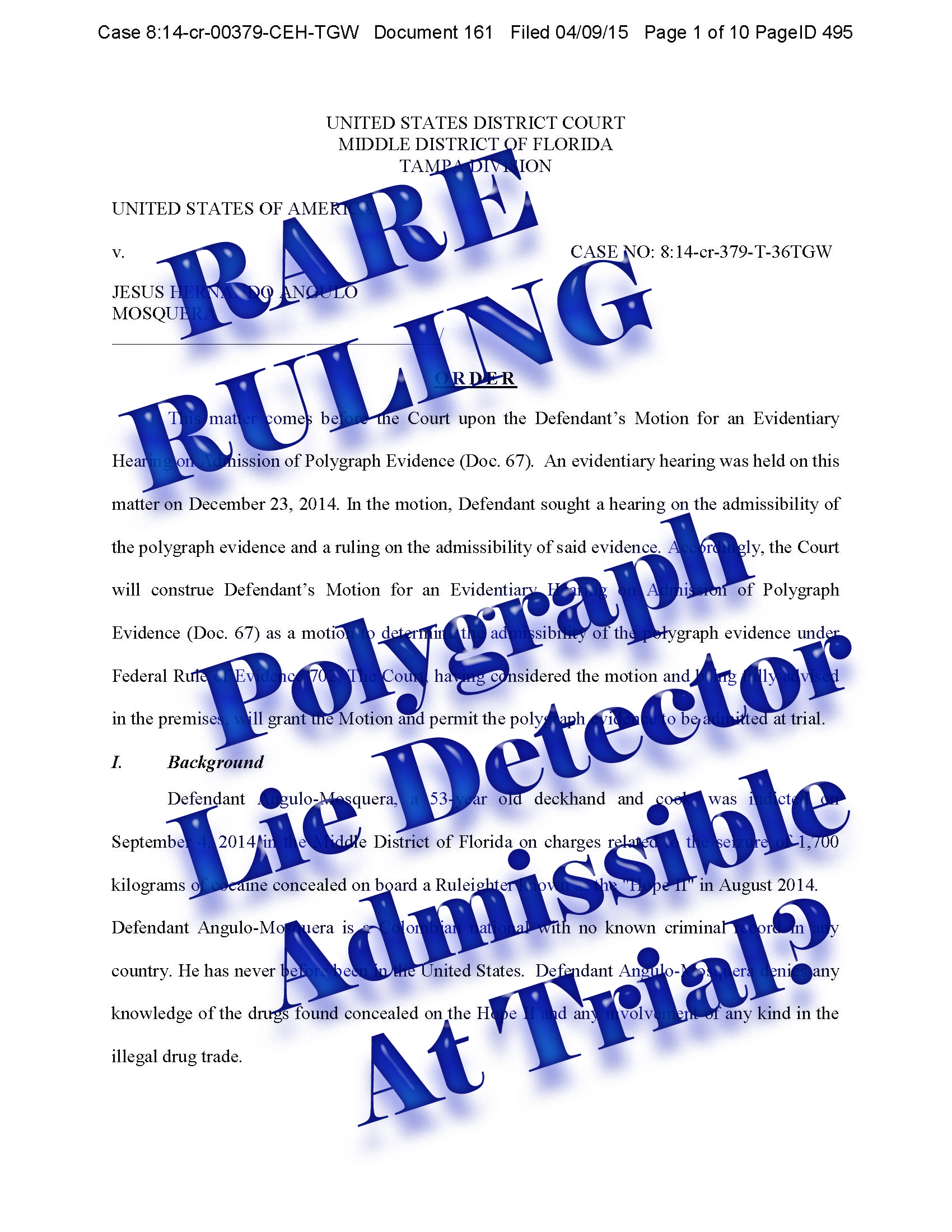
“Defendant Angulo-Mosquera, a 53-year old deckhand and cook, was indicted on September 4, 2014 in the Middle District of Florida on charges related to the seizure of 1,700 kilograms of cocaine concealed on board a freighter known as the “Hope II” in August 2014. Defendant Angulo-Mosquera is a Colombian national with no known criminal record in any country. He has never before been in the United States. Defendant Angulo-Mosquera denies any knowledge of the drugs found concealed on the Hope II and any involvement of any kind in the illegal drug trade.”

Is the Lie Detector | Polygraph | Admissible in Federal Court?


Yes. A United States District Judge in Florida’s Middle District, Judge Honeywell ruled in this Order that the court would allow admission of a polygraph performed by a former FBI agent on a defendant at trial. The defendant will testify at trial and has passed a pretrial polygraph.  Here are the relevant questions:

1. Did you know those drugs were on that ship before the Coast Guard boarded the ship? Answer: No.

2. Did you know those drugs were on the Hope II before the Coast Guard boarded that
ship? Answer: No.

3. Did you know those drugs were on that ship before the Coast Guard found them in
August? Answer: No.

Polygraph Case Excerpts:


“Defendant Angulo-Mosquera plans to testify in his own defense at trial and requests that the results of the polygraph examination be admitted into evidence to corroborate his testimony. The Government objects arguing that polygraph examinations are just “one step above” junkscience and are “not suitable for juror consumption.” TR at 46:15-24, 49:16-17. The results of the polygraph examination, if admitted at trial, would be presented through expert witness testimony.”

“[T]the Court held an evidentiary hearing to determine the admissibility of the polygraph evidence and expert testimony regarding same, under Federal Rule of Evidence 702 (“Rule 702”) and Daubert v. Merrell Dow Pharmaceuticals, Inc., 509 U.S. 579 (1993). At the hearing, Defendant Angulo-Mosquera presented the testimony of Dr. David C. Raskin, who for 44 years has conducted laboratory and field research on polygraph techniques for the detection of deception, taught university courses about polygraph techniques, trained government and law enforcement polygraph examiners, and published extensively on polygraph techniques, regarding the reliability of polygraph examinations in general and the examination in this case specifically.”

Junk Science Claim


“Defendant Angulo-Mosquera plans to testify in his own defense at trial and requests that the results of the polygraph examination be admitted into evidence to corroborate his testimony. The Government objects arguing that polygraph examinations are just “one step above” junk science and are “not suitable for juror consumption.” TR at 46:15-24, 49:16-17. The results of the polygraph examination, if admitted at trial, would be presented through expert witness testimony.”

“Thus, in determining the admissibility of expert testimony under Rule 702, courts must engage in a rigorous three-part inquiry, determining whether: (1) the expert is qualified to testify competently regarding the matters he intends to address; (2) the methodology by which the expert reaches his conclusions is sufficiently reliable as determined by the sort of inquiry mandated in Daubert; and (3) the testimony assists the trier of fact, through the application of scientific, technical, or specialized expertise, to understand the evidence or to determine a fact in issue.”

“Some factors that bear on this inquiry are: 1) whether the expert’s theories, methods or techniques can be or have been tested; 2) whether the technique, method, or theory has been subject to peer review and publications; 3) whether the known or potential rate of error of the technique when applied is acceptable; and 4) whether the technique, method, or theory has been generally accepted in the scientific community.”

Polygraph Ruling


“Thus, the Court finds the polygraph evidence to be admissible at trial to either impeach or corroborate witness testimony. Further specifics regarding the admission of the polygraph evidence will be determined at the time of trial. Accordingly, it is hereby ORDERED that Defendant’s Motion for an Evidentiary Hearing on Admission of Polygraph Evidence (Doc. 67), construed as a motion to determine the admissibility of the polygraph evidence under Federal Rule of Evidence 702, is GRANTED. The Defendant may present the polygraph evidence, through expert testimony, to corroborate or impeach witness testimony at the trial in this matter.”


United States Attorneys' Manual – Fully Searchable

United States Attorneys’ Manual
Fully Searchable

Here is an interesting read – a fully searchable copy of the United States Attorneys’ Manual. The document is available and has been posted under a standing Freedom of Information Act request. Learn about how the Department of Justice prosecutes cases by reviewing the Prosecutor’s Handbook, also known as The United States Attorneys’ Manual. Here are the guidelines used for indicting and prosecuting cases in Federal Court – Criminal Division Manual .

This is the same manual that is used in the Middle District of Florida. Here are a few interesting provisions dealing with how the Feds take property from citizens using Asset Forfeiture . Here is the prosecutor’s bible known as the United States Attorneys’ Manual .

Tampa Federal Criminal Defense Attorney Reviews DOJ Memo (Video)

Tweets From The Feds
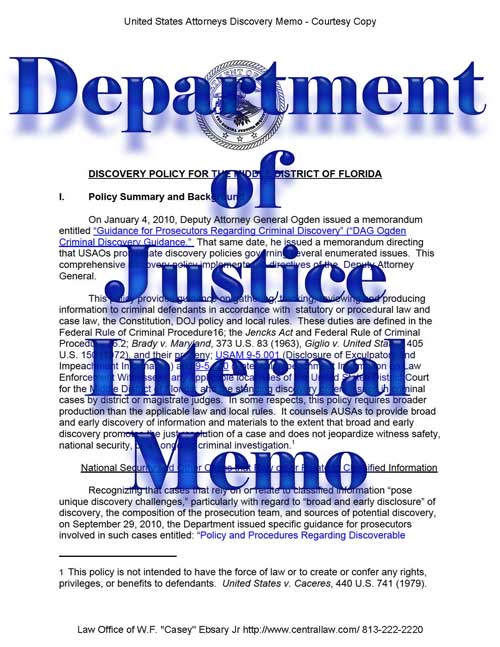
 

US_Attorney_Discovery_Memo tampa federal criminal defense attorney

United States Attorneys improperly concealed evidence – the U.S. Department of Justice ordered prosecutors to turn over information to criminal defense lawyers – here are their marching orders courtesy of a Tampa federal criminal defense attorney

Tampa Federal Criminal Defense Attorney notes that tweets are now discoverable in federal criminal cases. Because the Feds (United States Attorneys) were caught hiding evidence, the DOJ (United States Department of Justice) has written a memo on information to provide criminal defense attorneys. After 3 years, the memo has been released. Potential Sources of Discoverable Information include: Agency Files, Confidential Informant Files, Evidence, Gathered Information, Emails, Tweets, Text Messages, Memoranda, and Notes, etc.

Just obtained an internal memo from the Feds discussing all aspects of what the police and prosecutors must disclose to targets of federal prosecutions, including a warning that some tweets and social media use must be disclosed by Prosecutors in criminal cases. In short: Feds were caught hiding the ball and now must follow the rules in this detailed memo.

“tweets are now discoverable”

The new guidelines come from an investigation of case where United States Attorneys ( not in the Middle District of Florida ) were improperly concealing evidence. The memo may have been the result of prosecutors that improperly with held evidence  in the case of a United States Senator who was convicted by a jury. Days later the Justice Department dropped the charges.  After the Senator’s wrongful conviction, to cure these improprieties, the U.S. Department of Justice ordered prosecutors to draft memos on information to provide criminal defense lawyers – here are their marching orders.

Discover tweets: the Feds have

We initially received a tip from the Federal Defender, Eastern District of California. A complete copy of the United States Department of Justice Discovery Memo is available here. A video including the Attorney General’s statements on the problems with handling of evidence and the solution is included at the bottom of this post.

“The biggest problem is that nobody outside the prosecutor’s office actually knows what those policies are.”

The U.S. Department of Justice (USDOJ) ultimately released 73 individualized manuals for many federal district offices. There are links to the other Florida Federal Districts located at the end of this post. Florida has three districts. They are the Middle District, the Southern District, and the Northern District.

The Point: Feds were caught hiding the ball and now must follow the rules in this memo.

In the State court system, most prosecutors have a “open file” policy that ensures that whatever information is contained in the prosecutor’s file is available to defense attorneys. The lone exception has been state cases where police and prosecutors want to protect the identity of confidential sources. In  police reports these frequently appear as “CS” for confidential source or “CI” for confidential informant.

“written and unwritten statements are discoverable in federal criminal cases”


Discovery  Sources Bullet Points

  • Investigative Agency’s Files
  • Confidential Informant Files
  • Evidence and Information Gathered During Investigation
  • Documents or Evidence Gathered by Civil Attorneys
  • Emails, tweets, text messages, memoranda, notes
  • Personnel and Disciplinary Files
  • Handwritten Notes of Agents
  • Presentence Reports

Tampa Federal Criminal Defense Attorney on Discovery Practices


In 20 or so years of Federal Criminal practice in the Tampa Bay area the best course of action considered the fact: “rules for what prosecutors must share and when remained almost entirely secret. . . .” USA Today, filed a Freedom of Information Act request that forced the hand of the Federal Prosecutors to pull back the curtain on what must be provided to defense attorneys under the Constitution and Federal Rules of Criminal Procedure.

“it took the department nearly three years to release the policies”

“The biggest problem is that nobody outside the prosecutor’s office actually knows what those policies are.” said Timothy O’Toole of the National Association of Criminal Defense Lawyers (NACDL). According to USA Today, “it took the department [U.S. Department of Justice] nearly three years to release the policies from 74 U.S. attorneys’ offices . . . .”


Overview of the Federal Prosecutor Manual


Federal Rules of Criminal Procedure Rule 16 (b)


 “Most criminal defense attorneys immediately request that evidence be produced at the initial appearance”

As a starting point, “To trigger the government’s reciprocal discovery rights defined in Federal Rules of Criminal Procedure Rule 16 (b), the defendant must request discovery.” says a footnote in the document. The manual defines the scope of persons including law enforcement agencies and staff from whom investigative information should be obtained.  Most criminal defense attorneys immediately request that evidence be produced at the initial appearance or arraignment or detention hearing. The manual puts in writing the types of information available to defend federal criminal defendant by an exhaustive listing of what constitutes “discovery” or “discoverable information.”

Information Helpful to the Defense


“regardless of whether the prosecutor believes such information will make the difference between conviction and acquittal”

 The memo specifically instructs Assistant United States Attorneys (Prosecutors) that “[a] prosecutor must disclose information that is inconsistent with any element of any crime charged against the defendant or that establishes a recognized affirmative defense, regardless of whether the prosecutor believes such information will make the difference between conviction and acquittal of the defendant for a charged crime.” USAM 9-5.001 C 1.

Limit Use of Reports in Court


 “continue to object to use of the report”

Although the defense may get a report that includes witness statements, the manual reminds prosecutors to limit the use of statements in the reports. Especially when defense attorneys try to use the reports in cross-examination of witnesses in court. The memo states in part, “unless the witness has adopted the memorandum as his statement, AUSAs [Assistant United States Attorneys] should continue to object to use of the report in cross examination as if it were the witness’ statement.” See Page 9 of the Federal Prosecutor’s Memo.

Disclose Written and Unwritten Favorable Information


 “discussions cannot be avoided by failing to memorialize these events”

Sometimes police try to prevent helpful information from falling into the hands of the defense. To that end, the cops would not write down everything. They would fail to include helpful information in their reports. In a most remarkable requirement, the memo reminds prosecutors that, “[t]he duty to disclose to the defendant the substance of what a witness has said during interviews, debriefings, or informal discussions cannot be avoided by failing to memorialize these events. If any such events occur that are not memorialized in an interview report, the AUSA should determine what the witness said during the session and disclose the content of the witness’ statements to the defense. AUSAs should emphasize to agents the importance of memorializing all impeaching information.” See Page 10 of the Federal Prosecutor’s Memo.

The memo also extends prosecutors’ obligation to disclose to preparation of witnesses for trial. “The duty to disclose to the defendant the substance of what a witness has said during a pre-trial preparation session cannot be avoided by failing to memorialize it.” See Page 11 of the Federal Prosecutor’s Memo.

Who is Part of the Prosecution Team?


 “know which agencies have played a role in the investigation”

To prevent prosecutors from using claims that favorable information was not available to disclose, the memo explicitly describes who is a part of the prosecution’s team. “‘prosecution team’ is defined as  including ‘federal, state, and local law enforcement officers and other government officials participating in the investigation and prosecution of the criminal case against the defendant.’ The AUSA needs to know which agencies have played a role in the investigation and make all reasonable inquiries to ascertain what pertinent case information exists. When identifying members of the prosecution team, AUSAs should err on the side of inclusiveness . . . .” See Page 12 of the Federal Prosecutor’s Memo.


Excerpts from the U.S. Attorney’s Manual


Responsibility of AUSA(s)

The responsibility to produce all discoverable information in a criminal case lies with the AUSA(s) assigned to the case. To fulfill this responsibility, AUSAs should consider several matters:

• What & When: What are the policies, rules, statutes and case law that define what must be produced and when must it be produced? (See II. Laws, Rules and Policy Governing the Production of Discoverable
Information (What Must Be Produced and When?))

• Who is part of the prosecution team: AUSAs are obligated to produce information that is within the possession of the prosecution team; thus, defining the scope of the prosecution team is critical. (See III. Who is Part of the Prosecution Team: Gathering and Reviewing Potentially Discoverable Information)

• Where to look: Once the prosecution team has been identified, AUSAs must ensure that all discoverable information is located, reviewed and produced as required, including agency investigative and administrative files, CI files, emails, PSRs, law enforcement Giglio, etc. (See IV. Potential Sources of Discoverable Information)

• How to produce and track: AUSAs must decide in what form to produce the discovery (bates numbered, hard copy, e-copy, available for inspection, redacted, etc), and must keep a detailed record of all discovery produced. (See V. Manner of Production and Recordkeeping) See Page 2 of the Federal Prosecutor’s Memo.

Scope of Criminal Discovery in Federal Cases

“For the purposes of this memorandum, “discovery” or “discoverable information” is not limited to Federal Rule of Criminal Procedure 16 information, but also includes all information and materials the
government must disclose to the defendant pursuant to the Jencks Act and Federal Rule of Criminal Procedure 26.2; Federal Rule of Evidence 404(b); Brady, Giglio, USAM 9-5.001 and 9-5.100; any applicable local rules; and the any applicable standing discovery order in a criminal case.” See Page 3 of the Federal Prosecutor’s Memo.

Memo Policies Must be Followed

“Deviation from the policy of production of reports of witness interviews requires Criminal Chief or Deputy Criminal Chief approval.” See Page 9 of the Federal Prosecutor’s Memo.

Not All Witness Statements are Created Equal

“Be careful not to characterize a witness interview as a Jencks Act statement in discovery letters or court pleadings”

“The Jencks Act defines “witness statements” as … “(1) a written statement made by [a] witness and signed or otherwise adopted or approved by him; (2) a stenographic, mechanical, electrical, or other recording, or a transcription thereof, which is a substantially verbatim recital of an oral statement made by [the] witness and recorded contemporaneously with the making of such oral statement; or (3) a statement, however taken or recorded, or a transcription thereof, if any, made by [a] witness to a grand jury.” 18 U.S.C. § 3500 (e).

“[U]nless the witness has adopted the memorandum as his statement, AUSAs should continue to object to use of the report in cross examination as if it were the witness’ statement.”  See Page 9 of the Federal Prosecutor’s Memo.

Helpful Information Must be Disclosed – Written or Not

“Memorializing Favorable Information and the Duty to Disclose. The duty to disclose to the defendant the substance of what a witness has said during interviews, debriefings, or informal discussions cannot be avoided by failing to memorialize these events. If any such events occur that are not memorialized in an interview report, the AUSA should determine what the witness said during the session and disclose the content of the witness’ statements to the defense. AUSAs should emphasize to agents the importance of memorializing all impeaching information.” See Page 10 of the Federal Prosecutor’s Memo. (underlining in original).

Witness Interview and Preparation – Continuing Duty to Disclose

“The duty to disclose to the defendant the substance of what a witness has said during a pre-trial preparation session cannot be avoided by failing to memorialize it.” See Page 11 of the Federal Prosecutor’s Memo.


Video – Attorney General Holder on the Discovery Memo


Other Florida Federal District Court Discovery Manuals


Florida – Northern District

Florida – Southern District

Sources:
https://www.usatoday.com/story/news/2015/03/03/justice-department-discovery-policies-released/24239225/
https://www.justice.gov/dag/memorandum-heads-department-litigating-components-handling-criminal-matters-all-united-states


Questions on Tampa Federal Criminal Issues?
Call Us 24/7/365 (813) 222-2220

Law Office of W.F. ''Casey'' Ebsary Jr

2102 W Cleveland St
Tampa, FL 33606
US

Fax: (813) 225-0202

Email: centrallaw@centrallaw.com

Map and Directions

Florida Felony and Misdemeanor | Statute of Limitations | Theft and other Charges

Florida Criminal Statute of Limitations

“Time starts to run on the day after the offense is committed.”
Statute of Limitations

Frequently Asked Questions


How long can prosecutors wait to go forward on a criminal case?

What is the Statute of Limitations for criminal cases in Florida? 

The Florida Criminal Statute of Limitations, Theft, Drug and general Felony Statutes of Limitations sometimes depends on the nature of the criminal charges. Under Florida law:

  • Second degree misdemeanor must commence within one (1) year of the alleged incident;
  • First degree misdemeanor has two (2) years to commence prosecution;
  • First Degree (1st) felonies are 4 years; and
  • All other felonies (2nd and 3rd Degree) are 3 years.

The Statute provides, in part:

775.15 Time limitations; general time limitations; exceptions.—

(1)A prosecution for a capital felony, a life felony, or a felony that resulted in a death may be commenced at any time. If the death penalty is held to be unconstitutional by the Florida Supreme Court or the United States Supreme Court, all crimes designated as capital felonies shall be considered life felonies for the purposes of this section, and prosecution for such crimes may be commenced at any time.
(2)Except as otherwise provided in this section, prosecutions for other offenses are subject to the following periods of limitation:

(a)A prosecution for a felony of the first degree must be commenced within 4 years after it is committed.


(b)A prosecution for any other felony must be commenced within 3 years after it is committed.

(c)A prosecution for a misdemeanor of the first degree must be commenced within 2 years after it is committed.

(d)A prosecution for a misdemeanor of the second degree or a noncriminal violation must be commenced within 1 year after it is committed.

(3)An offense is committed either when every element has occurred or, if a legislative purpose to prohibit a continuing course of conduct plainly appears, at the time when the course of conduct or the defendant’s complicity therein is terminated. Time starts to run on the day after the offense is committed.

Continue reading

Horton Hears a Judge in Court

Dr. Seuss: A Guide to Criminal Defense

Dr. Seuss: A Guide by a Tampa Criminal Defense Attorney

 “Lawyers cite these classics in official documents with pride”

As a Tampa Criminal Defense Attorney, I can say with certainty that the works of Theodore Geisel, more commonly known under his pseudonym Dr. Seuss, are not a body of literature one would expect to see cited nor mentioned in a court of law. However, as America is often a place where impossible sounding things happen with alarming frequency, it is not as hard as you would think to find a legal precedent for this phenomena. There are appeals courts that have used the Doctor and there is at least one trial court that has used Dr. Seuss as authority for a legal opinion. More about that later.

One Fish Two Fish: A Fish Is A Fish No Matter What You Wish.


Dr. Seuss on Criminal Defense at Sea

Dr. Seuss on Criminal Defense at Sea

The US Supreme Court reeled in a few #CopsGoneWild who convinced a Federal Prosecutor to indict and prosecute a fisherman near Tampa, Florida. The court overturned the conviction obtained for destruction of records. Fish are obviously not records. The Supreme Court said, “A fish is, of course, a discrete thing that possesses physical form. See generally Dr. Seuss, One Fish Two Fish Red Fish Blue Fish (1960).” Yates v United States, 574 US ____ (2015) ( Docket No. 13-7451).

Cat In The Hat: Criminal Defendant: Not That Cat


“admitted committing this crime and indicated he did it with a man adorned in a Dr. Seuss ‘Cat in the Hat’ hat”


The Cat in the Hat Comes Back to Court

The Cat in the Hat Comes Back to Court as one Judge waxes poetic

A criminal defendant dragged these beloved characters into a courtroom “Mr. Howard was charged as a principal in the armed robbery of a convenience store that was committed by two men. At Mr. Howard’s trial, the State presented the testimony of a man who had admitted committing this crime and indicated he did it with a man adorned in a Dr. Seuss ‘Cat in the Hat’ hat, whom he knew as “Bear.” The State had other evidence tending to establish that Mr. Howard was ‘Bear’.” Howard v State 869 So. 2d 725, (2d DCA 2004).

Horton Hears A Who: Judges On Mission To Repeat Repetition


 “the elephant, meant what it said and said what it meant”


Horton Hears a Judge in Court

Horton Hears the Judge

In a collision of litigants in a personal injury suit, the Judge was incensed that someone had missed a court date. With regard to instructions to appear for court proceedings, ” like Dr. Seuss’s Horton the elephant, [the court] meant what it said and said what it meant.” Mourning v Ballast 32 Fla. L. Weekly D 1673 ( 4th DCA 2007 )

Floridians went to war over a boat slip in Palm Beach. The court noted, “the Florida Supreme Court, like Dr. Seuss’s Horton the elephant, meant what it said and said what it meant. . . ” Graham v Yeskel Trust 928 So. 2d 371 (2006). I don’t know what the court meant, but this is about Dr. Seuss in court.

A United States District Court Judge Elizabeth Kovachevich instructed the lawyers in “The words of Horton the Elephant come to mind: “I meant what I said, and I said what I meant. An elephant’s faithful one-hundred percent!” Dr. Seuss, Horton Hatches the Egg.” Campero v ADS Foodservice 916 F. Supp. 2d 1284 ( SD Fla 2012 ).

My Name is Seuss: I am not a Doctor


 “Seuss entered a plea of nolo contendere to possession of marijuana in excess of 100 pounds”


There was an unfortunate defendant named Seuss who was detained by police who threatened to get a warrant. Seuss v. State, 370 So. 2d 1203 (Fla. 1st DCA 1979) (threats to get a warrant, prolonged detention). Poor Jack Seuss “Seuss entered a plea of nolo contendere to possession of marijuana in excess of 100 pounds . . . .” The opinion continued, “Seuss had been detained for more than an hour; he had refused repeated requests that he open the vehicle and allow the agents to inspect; he was informed that he could not leave until the vehicle was searched . . . .” Seuss walked away from the charges when the court ruled that threats to get a search warrant were baseless. supervisor represented that if Seuss continued to refuse, he could get authority to search anyway. . . . The court found the cops should have gotten the search warrant rather than detain gangapreneur Seuss for over an hour while attempting to obtain his “consent.”

Cat In The Hat: Intellectual Property Law: Source of A Kerfuffle Fee Faw.


 “The Cat Not in the Hat! A Parody by Dr. Juice”


The Cat in the Hat Comes Back to Court

The Cat in the Hat Comes Back to Court as one Judge waxes poetic

In the 1990’s Dr. Seuss Enterprises became entangled in a case that was rejected by the United States Supreme Court. Penguin Books USA, Inc., et al. v. Dr. Seuss Enterprises, L.P. 521 U.S. 1146 (1997). “The Cat Not in the Hat! A Parody by Dr. Juice, a work poised to supply a “fresh new look” at the O.J. Simpson double-murder trial. Katz’s rhymes, the illustrations provided by Chris Wrinn, and the book’s packaging by the manufacturer defendants *fn1″ (the individual and corporate defendants are referred to collectively hereinafter as “Penguin”) mimic the distinctive style of the family of works created by Theodor S. Geisel, better known as Dr. Seuss.”

“Dr. Seuss has made a strong showing as to its copyright claims”


The court ruled, “Dr. Seuss has made a strong showing as to its copyright claims, and has raised serious questions providing a fair basis for litigation as to its trademark claims. The balance of the hardships tips markedly in its favor. A likely copyright infringement appears on the back cover of Penguin’s work, and instances of possible trademark infringements of the stove pipe hat appear on the front and back covers and throughout the work.”

“Defendants are therefore enjoined, pending trial of this action, from directly or indirectly printing, publishing, delivering, distributing, selling, transferring, advertising, or marketing the book The Cat Not in the Hat! A Parody by Dr. Juice.” Penguin Books USA, Inc., et al. v. Dr. Seuss Enterprises, L.P. (1996) https://ca.findacase.com/research/wfrmDocViewer.aspx/xq/fac.19960426_0000015.SCA.htm/qx

Yertle The Turtle: Yertle The Turtle Heightens Fertile First Amendment Hurdle!


 “I’m king, and you’re only a turtle named Mack.”


Yertle the Turtle: All the Turtles are Free

Yertle the Turtle: All the Turtles are Free

In Texas, Yertle The Turtle made an appearance when a judge scribbled a judge blurted “”Silence,” the King of the Turtles barked back, “I’m king, and you’re only a turtle named Mack.” Seuss (T. Geisel), Yertle The Turtle and Other Stories, Random House (1950). The court continued, “Dr. Seuss’ rhyming narrative about Yertle, The Turtle, concludes: “And the turtles, of course . . . All the turtles are free As turtles and, maybe, all creatures should be.” The court quipped in the context of employees’ first amendment rights. Davis v. Williams, 598 F.2d 916 ( 5th Cir 1979 ).

One Fish Two Fish: A Fish Is A Fish No Matter What You Wish.


 “conduct did not run afoul (or a fish)”


Dr. Seuss on Criminal Defense at Sea

Dr. Seuss on Criminal Defense at Sea

One legal expert has said, “A fish is still a fish, but it is not a tangible object under 18 U.S.C. Section 519” says legal scholar Solomon Wisenberg. Wisenburg quipped “The Court ruled 5-4 that Yates’ conduct did not run afoul (or a fish) of 1519, because the little fishies were not tangible objects under that particular statute . . . .”  Check out the White Collar Law Blog here.

Stetson Law School Professor Ellen Podgor then joined the conversation, “The recognition by these dissenting justices of the growing problem of overcriminalization in the United States is an important step. In many ways this decision is really a 9-0 decision in that the plurality tossed the fish case out because it did not fit in this sea. ”  See Professor Podgor’s Take on this Federal Criminal Case Here.

Seuss Landing: Your Injury? Judge Responds With Fury!


Finally, Universal Studios Orlando was the site of a war over the “Seuss Landing” project in Orlando, Florida. Whiting v US Fidelity 2006 U.S. Dist. LEXIS 40456 ( MD Fla 2006 ).

The End – My Friend


Tampa Criminal Defense Attorney Editorial Board Member of Law Review Certificate

Tampa Criminal Defense Attorney Editorial Board Member of Law Review

Perhaps in the future, scholars will revile at our society’s use of books relegated to the status of children’s literature. But I await a future where Tampa Criminal Defense Lawyers cite these classics in official documents with pride.

Dr. Seuss Titles:

Yertle The Turtle: Yertle The Turtle Heightens Fertile First Amendment Hurdle!

Seuss Landing: Personal Injury? Judge Responds With Fury!

One Fish Two Fish: A Fish Is A Fish No Matter What You Wish.

Cat In The Hat: Intellectual Property Law: Source of A Kerfuffle Fee Faw.

Horton Hears A Who: Judges On Mission To Repeat Repetition

Infographic – Dr. Seuss Goes to Court


Dr Seuss Goes to Court - Criminal Defense Dr Suess Infographic

Dr Seuss Goes to Court – Criminal Defense Dr Suess Infographic

BATT1000 BATTERY (TOUCH OR STRIKE)

“Actually and intentionally touches or strikes 
another person against the will of the other”


Battery Misdemeanor, BATT1000, BATTERY (TOUCH OR STRIKE)

Battery Misdemeanor, BATT1000, BATTERY (TOUCH OR STRIKE)

Battery Misdemeanor

Battery Misdemeanor


Battery is Number 14 on our list of criminal charges that are used to justify an arrest in Tampa’s Hillsborough County, Florida. We reviewed the top criminal charges included in the Hillsborough County Jail records. We narrowed the list down to the top 50 ways to end up in jail and have shared them here.

If the charge involves domestic relationships, then you can be charged with Domestic Violence Battery. That is the 6th most popular way to get arrested on the west coast of Florida.


If you have been charged with BATT1000 BATTERY (TOUCH OR STRIKE) you can call a Tampa Criminal Defense Attorney at 813-222-2220 to Fight for You.


Form Code: BATT1000


Florida Statute: 784.03.1AB
Level: Misd (Misdemeanor)
Degree: 1st
Description: BATTERY (TOUCH OR STRIKE)

BATT1000 BATTERY (TOUCH OR STRIKE) one of the most commonly charged offenses in Hillsborough County, Florida.

Chapter 784 ASSAULT; BATTERY; CULPABLE NEGLIGENCE

“conviction means a determination of guilt . . . regardless of whether adjudication is withheld”

784.03 Battery; felony battery.


(1)(a) The offense of battery occurs when a person:

1. Actually and intentionally touches or strikes another person against the will of the other; or


2. Intentionally causes bodily harm to another person.

(b) Except as provided in subsection (2), a person who commits battery commits a misdemeanor of the first degree, punishable as provided in s. 775.082 or s. 775.083.


“second or subsequent battery commits a 

felony of the third degree”

(2) A person who has one prior conviction for battery, aggravated battery, or felony battery and who commits any second or subsequent battery commits a felony of the third degree, punishable as provided in s. 775.082, s. 775.083, or s. 775.084. For purposes of this subsection, “conviction” means a determination of guilt that is the result of a plea or a trial, regardless of whether adjudication is withheld or a plea of nolo contendere is entered.

Tampa Drug Lawyer on Marijuana Drones | Your Legal Defense Options | Video

Law Enforcement Drones - Tampa Drug Lawyer on Marijuana, Drones & Your Legal Defense Options

Marijuana Drones Drugs and Defenses – Tampa Drug Lawyer on Marijuana, Drones & Your Legal Defense Options

In 1989, a soon-to-be former drug crimes prosecutor and now a Tampa Drug Lawyer  published an article in prominent law review. Almost 25 years ago, Florida and the Feds were in the middle of the war on drugs and marijuana. That was before the rise of the machines – the drones. Recently, the Feds are issuing rules for use of drones ( unmanned aircraft systems or UAS ) by the public. Conspicuously absent from the new proposed are rules for the cops. The Supreme Court has not addressed the rise of the drones. As noted over 20 years ago before I was a prosecutor and now a Tampa Drug Lawyer:

“The United States Supreme Court must apprise itself of the emergent and contemporary technologies that have rendered its prior holdings lethal weapons to the provisions of a Constitution originally drafted to prevent invasions into the private lives of citizens.”

No Search Warrants Needed for Residential Property by Drones


Because of recent Federal regulations regarding the use of unmanned aerial drones, we can no longer assume  the right to privacy in our own yards, homes, property, or businesses is intact. Since the United States Supreme Court decided that a helicopter with a high-powered camera aimed at a Florida Marijuana grow house did not constitute a search. If anything is visible from any vantage point that a an aerial drone may take, this information can be used against us in a court of law without requiring a Search Warrant.

“With digital cameras, 2,000 mm digital lenses with magnification of over 40x, placement of a drone with highly capable optics outside of homes and businesses is frightening.” 

Police Use of Drones

Florida Statute 934.50 Limits Use of Drones by Police

Florida Limits Use of Drones by Law Enforcement


Florida Statute 934.50 limits Searches and seizure using a drone. The Florida law on drone searches is called the “Freedom from Unwarranted Surveillance Act.” The law may limit use of these aircraft in a way that the new federal proposed regulations has missed. Under this law, a law enforcement agency may not use a drone to gather evidence or other information, unless “the law enforcement agency first obtains a search warrant signed by a judge authorizing the use of a drone.” One of the exceptions may be used by cops to avoid suppression of evidence. “If the law enforcement agency possesses reasonable suspicion that, under particular circumstances, swift action is needed to prevent imminent danger to life or serious damage to property, to forestall the imminent escape of a suspect or the destruction of evidence, or to achieve purposes including, but not limited to, facilitating the search for a missing person.” The penalties for failure to comply with the law are, “a civil action against a law enforcement agency to obtain all appropriate relief in order to prevent or remedy a violation of this act . . . [and evidence] obtained or collected in violation of this act is not admissible as evidence in a criminal prosecution in any court of law in this state.”

Summary of DOT and FAA Proposed New Rules for Small Unmanned Aircraft Systems from a Tampa Drug Lawyer


The feds have said, “Generally speaking, the new rules would not apply to government aircraft operations, because we expect that these government operations will typically continue to actively operate under the Certificate of Waiver or Authorization (COA) process unless the operator opts to comply with and fly under the new small UAS regulations.” In practice the police may not even have to abide by the new rules.

The FAA has previously announced, “Common public uses today include law enforcement, firefighting, border patrol, disaster relief, search and rescue, military training, and other government operational missions.” The FAA knows about these uses and they appear to be authorized.

See https://www.faa.gov/uas/public_operations/

 Video – Unmanned Aircraft Drone Usage Rules


Here are the key provisions. A small unmanned aircraft system or UAS  is under 55 pounds; flights limited to daylight and visual-line-of-sight operations; there are height restrictions; operator certification; use of another visual observer; registration and marking of the drone; and operational limits. Drone flights are limited to 500 feet altitude and no faster than 100 mph.

Seven More Things to Know about Drone Usage


The new rule also proposes operating limitations designed to minimize risks to other aircraft and people and property on the ground: 1) A small UAS operator must always see and avoid manned aircraft. 2) If there is a risk of collision, the UAS operator must be the first to maneuver away. 3) The operator must discontinue the flight when continuing would pose a hazard to other aircraft, people or property. 4) A small UAS operator must assess weather conditions, airspace restrictions and the location of people to lessen risks if he or she loses control of the UAS. 5) A small UAS may not fly over people, except those directly involved with the flight. 6) Flights should be limited to 500 feet altitude and no faster than 100 mph. 7) Operators must stay out of airport flight paths and restricted airspace areas, and obey any FAA Temporary Flight Restrictions (TFRs).

Here is a link to the Proposed New Rules for Small Unmanned Aircraft Systems

Here is a link to the FAA Press Release on the Drone Rules

Here is link to the Tech Crunch Story on Small Unmanned Aircraft Systems

Excerpts From 1989 Law Review Article on Marijuana Grow House Surveillance


Before I was a drug lawyer in Tampa, while a member of the Stetson Law Review in 1989-90, I became concerned with the use of technology against citizens. At the time, helicopters and aircraft were equipped with film cameras and 500 mm lenses. This allowed a magnification of about 10x. With digital cameras, 2,000 mm digital lenses with magnification of over 40x, placement of a drone with highly capable optics outside of homes and businesses is frightening.

Fourth Amendment Aerial Privacy: Expect the Unexpected
By W.F. “Casey” Ebsary, Jr. 19 Stetson Law Review 273 (1990)

Michael Riley was growing marijuana in a greenhouse behind his home in rural Pasco County, Florida. A fenced yard surrounded both the greenhouse and Riley’s home. The greenhouse was enclosed on two sides, and the view into one of the remaining sides was obscured by shrubbery within the fenced perimeter. The other open side was shielded from view by the home. The contents of the greenhouse were not visible from the ground.
. . .

The Riley case is significant because it is now questionable whether there are reasonable expectations to be free from the probing eye of the government above. Even those activities within the close confines of the home are now subject to aerial scrutiny. Therefore, activity which one wishes to remain private must now be confined to areas strictly within the walls of the home, with the curtains securely drawn. The Court’s rejection of Riley’s privacy claim signals the continued erosion of personal privacy rights under the fourth amendment.
. . .

Emergent technologies may sculpt the fourth amendment’s protections of privacy rights. Katz indirectly addressed the issue of technological advances and their impact upon fourth amendment privacy rights. Justice Harlan stated that the “legitimate needs of law enforcement may demand specific exceptions” to the warrant requirement; however, the Justice deferred consideration of these circumstances to such time as they were presented to the Court. Such circumstances arose in 1986 when the Court again visited both the curtilage and open field doctrines.
. . .

The Supreme Court has nearly eliminated any right which a citizen has to aerial privacy. Such privacy, if it ever existed, is all but gone as we have reached a point where further erosion of citizens’ fourth amendment rights to aerial privacy is not easy to envision. After the recent line of aerial privacy decisions in Ciraolo, Dow, and now Riley, the public can be reasonably certain that the government will be able to aerially observe ground activities, free from the restraint of the fourth amendment. Even with the curtains drawn, it is conceivable that from an aerial perch an officer could peer into the home through a crack in the curtains and be free to report his observations and use such information to the government’s advantage.
. . .

CONCLUSION

The United States Supreme Court must apprise itself of the emergent and contemporary technologies that have rendered its prior holdings lethal weapons to the provisions of a Constitution originally drafted to prevent invasions into the private lives of citizens. The Court must reconsider its application of the Katz  standard in approaching aerial privacy claims. Otherwise, we will all be expected to expect the unexpected.

Complete Article is here:

https://www.stetson.edu/law/lawreview/media/19StetsonLRev1.pdf

Complete Text of Florida Drone Law:

934.50 Searches and seizure using a drone.—
(1) SHORT TITLE.—This act may be cited as the “Freedom from Unwarranted Surveillance Act.”

(2) DEFINITIONS.—As used in this act, the term:
(a) “Drone” means a powered, aerial vehicle that:
1. Does not carry a human operator;
2. Uses aerodynamic forces to provide vehicle lift;
3. Can fly autonomously or be piloted remotely;
4. Can be expendable or recoverable; and
5. Can carry a lethal or nonlethal payload.
(b) “Law enforcement agency” means a lawfully established state or local public agency that is responsible for the prevention and detection of crime, local government code enforcement, and the enforcement of penal, traffic, regulatory, game, or controlled substance laws.

(3) PROHIBITED USE OF DRONES.—A law enforcement agency may not use a drone to gather evidence or other information.

(4) EXCEPTIONS.—This act does not prohibit the use of a drone:
(a) To counter a high risk of a terrorist attack by a specific individual or organization if the United States Secretary of Homeland Security determines that credible intelligence indicates that there is such a risk.
(b) If the law enforcement agency first obtains a search warrant signed by a judge authorizing the use of a drone.
(c) If the law enforcement agency possesses reasonable suspicion that, under particular circumstances, swift action is needed to prevent imminent danger to life or serious damage to property, to forestall the imminent escape of a suspect or the destruction of evidence, or to achieve purposes including, but not limited to, facilitating the search for a missing person.

(5) REMEDIES FOR VIOLATION.—An aggrieved party may initiate a civil action against a law enforcement agency to obtain all appropriate relief in order to prevent or remedy a violation of this act.

(6) PROHIBITION ON USE OF EVIDENCE.—Evidence obtained or collected in violation of this act is not admissible as evidence in a criminal prosecution in any court of law in this state.

History.—s. 1, ch. 2013-33.

THEF1010 PETIT THEFT 1st – Misdemeanor Petit Theft

Misdemeanor Petit Theft


Petit Theft is one of the most commonly charged offenses in Florida.  If someone has no prior record, a conviction can be avoided and a Motion to Seal the records can keep this mistake from permanently hurting lives.


Misdemeanor Petit Theft

Misdemeanor Petit Theft

Petit Theft

If you have been charged with THEF1010 PETIT THEFT 1st you can call a  Defense Attorney  in Tampa to Fight for You or a friend.


Form Code: THEF1010


Florida Statute: 812.014.2E
Level: Misd (Misdemeanor)
Degree: 1st
Description: PETIT THEFT 1st

THEF1010 PETIT THEFT 1st is one of the most commonly charged offenses in Hillsborough County, Florida.


“obtains or uses, or endeavors to obtain or to use, the property of another”

Chapter 812 THEFT, ROBBERY, AND RELATED CRIMES812.014 Theft.(1) A person commits theft if he or she knowingly obtains or uses, or endeavors to obtain or to use, the property of another with intent to, either temporarily or permanently:(a) Deprive the other person of a right to the property or a benefit from the property.(b) Appropriate the property to his or her own use or to the use of any person not entitled to the use of the property.

It is grand theft of the third degree and a felony of the third degree
. . . if the property stolen is . . . Valued at $300 or more, but less than $5,000
(2)(a) 1. If the property stolen is valued at $100,000 or more or is a semitrailer that was deployed by a law enforcement officer; or
2. If the property stolen is cargo valued at $50,000 or more that has entered the stream of interstate or intrastate commerce from the shipper’s loading platform to the consignee’s receiving dock;
or
3. If the offender commits any grand theft and:a. In the course of committing the offense the offender uses a motor vehicle as an instrumentality, other than merely as a getaway vehicle, to assist in committing the offense and thereby damages the real property of another; orb. In the course of committing the offense the offender causes damage to the real or personal property of another in excess of $1,000, the offender commits grand theft in the first degree, punishable as a felony of the first degree, as provided in s. 775.082, s. 775.083, or s. 775.084.(b) 1. If the property stolen is valued at $20,000 or more, but less than $100,000;2. The property stolen is cargo valued at less than $50,000 that has entered the stream of interstate or intrastate commerce from the shipper’s loading platform to the consignee’s receiving dock;3. The property stolen is emergency medical equipment, valued at $300 or more, that is taken from a facility licensed under chapter 395 or from an aircraft or vehicle permitted under chapter 401; or4. The property stolen is law enforcement equipment, valued at $300 or more, that is taken from an authorized emergency vehicle, as defined in s. 316.003, the offender commits grand theft in the second degree, punishable as a felony of the second degree, as provided in s. 775.082, s. 775.083, or s. 775.084. Emergency medical equipment means mechanical or electronic apparatus used to provide emergency services and care as defined in s. 395.002(9) or to treat medical emergencies. Law enforcement equipment means any property, device, or apparatus used by any law enforcement officer as defined in s. 943.10 in the officer’s official business.
However, if the property is stolen within a county that is subject to a state of emergency declared by the Governor under chapter 252, the theft is committed after the declaration of emergency is made, and the perpetration of the theft is facilitated by conditions arising from the emergency, the theft is a felony of the first degree, punishable as provided in s. 775.082, s. 775.083, or s. 775.084. As used in this paragraph, the term “conditions arising from the emergency” means civil unrest, power outages, curfews, voluntary or mandatory evacuations, or a reduction in the presence of or response time for first responders or homeland security personnel.
For purposes of sentencing under chapter 921, a felony offense that is reclassified under this paragraph is ranked one level above the ranking under s. 921.0022 or s. 921.0023 of the offense committed.(c) It is grand theft of the third degree and a felony of the third degree, punishable as provided in s. 775.082, s. 775.083, or s. 775.084, if the property stolen is:1. Valued at $300 or more, but less than $5,000.2. Valued at $5,000 or more, but less than $10,000.3. Valued at $10,000 or more, but less than $20,000.
4. A will, codicil, or other testamentary instrument.5. A firearm.6. A motor vehicle, except as provided in paragraph (a).7. Any commercially farmed animal, including any animal of the equine, bovine, or swine class, or other grazing animal, and including aquaculture species raised at a certified aquaculture facility. If the property stolen is aquaculture species raised at a certified aquaculture facility, then a $10,000 fine shall be imposed.8. Any fire extinguisher.9. Any amount of citrus fruit consisting of 2,000 or more individual pieces of fruit.10. Taken from a designated construction site identified by the posting of a sign as provided for in s. 810.09(2)(d).11. Any stop sign.12. Anhydrous ammonia.However, if the property is stolen within a county that is subject to a state of emergency declared by the Governor under chapter 252, the property is stolen after the declaration of emergency is made, and the perpetration of the theft is facilitated by conditions arising from the emergency, the offender commits a felony of the second degree, punishable as provided in s. 775.082, s. 775.083, or s. 775.084, if the property is valued at $5,000 or more, but less than $10,000, as provided under subparagraph 2., or if the property is valued at $10,000 or more, but less than $20,000, as provided under subparagraph 3. As used in this paragraph, the term “conditions arising from the emergency” means civil unrest, power outages, curfews, voluntary or mandatory evacuations, or a reduction in the presence of or the response time for first responders or homeland security personnel. For purposes of sentencing under chapter 921, a felony offense that is reclassified under this paragraph is ranked one level above the ranking under s. 921.0022 or s. 921.0023 of the offense committed.(d) It is grand theft of the third degree and a felony of the third degree, punishable as provided in s. 775.082, s. 775.083, or s. 775.084, if the property stolen is valued at $100 or more, but less than $300, and is taken from a dwelling as defined in s. 810.011(2) or from the unenclosed curtilage of a dwelling pursuant to s. 810.09(1).(e) Except as provided in paragraph (d), if the property stolen is valued at $100 or more, but less than $300, the offender commits petit theft of the first degree, punishable as a misdemeanor of the first degree, as provided in s. 775.082 or s. 775.083.

Deportation of Cuban Nationals From United States

Cuba, Deportation, lawful permanent resident, ICE, LPR
Deportation of Cuban Nationals

Deportation of Cuban Nationals From the United States remains an open question for Federal Criminal Defense Attorneys in United States District Courts. One source says, “At this point we do not know how/when the normalization will impact the U.S.’s ability to deport Cuban individuals.  At any rate, those who are in lawful status and not subject to any grounds of deportation (i.e. those who entered, obtained lawful permanent resident status, and do not have crimes that make them deportable) do not need to worry.  The main impact will be on those who either fell out of status and can’t fix their status now (for example, those who were paroled in and then never applied for lawful permanent resident status, and who are not eligible for LPR status due to crimes) and those who already have deportation orders but were released from ICE custody on ICE orders of supervision because they could not be physically deported.”

UPDATE – Deportation of Cuban Nationals


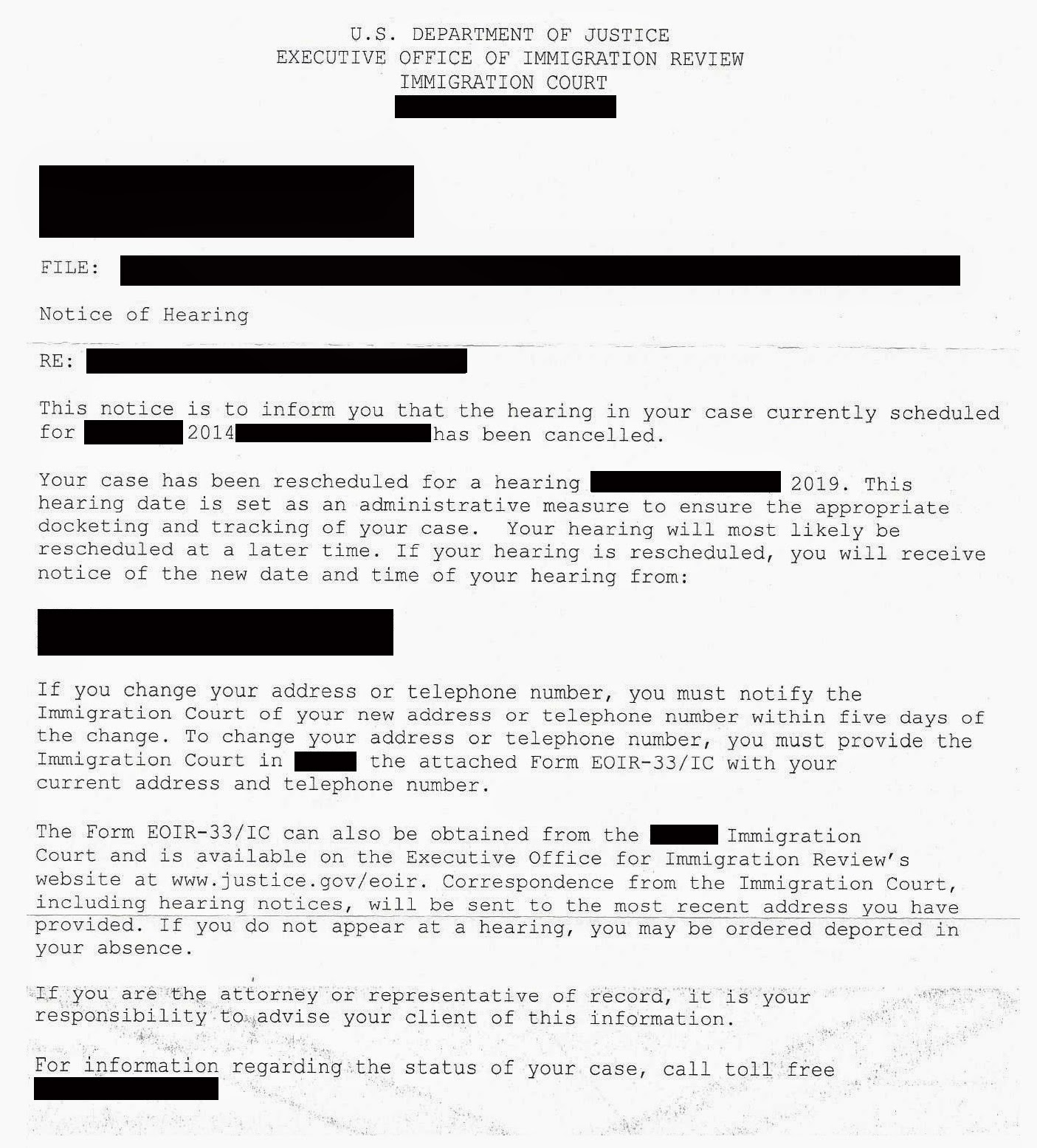
“The notice includes a warning: 

If you do not appear at a hearing, 
you may be ordered deported in your absence.”


Notice of Hearing, Cuba, Deportation, ICE, lawful permanent resident, LPR
Sample Notice of Hearing

There is at least one case where the deportation proceedings of a Cuban national was reset to 2019, almost four years after the initial notice from the Immigration Court. A sample Notice of Hearing is included in this article. The notice includes a warning that “If you do not appear at a hearing, you may be ordered deported in your absence.”

Furthermore the source advises, “At this point, I think it’s important to advise Cuban clients that deportation may be a reality soon and that they should be careful to avoid criminal activity and pleading to offenses that will bring them to ICE’s attention/subject them to criminal grounds of deportation.  Basically, after years of not having to face full immigration consequences (physical deportation) of criminal convictions, they will now have to seriously consider those consequences.”
Contribute to NIJC and provide critical legal services to families in the coming year!