History of Cell Phone Searches

Cell Phone Search Warrant

Cell Phone Search Warrant, Cell Phone Search, Search and Seizure

Search Warrant
Cell Phone

Cell Phone Search Warrant


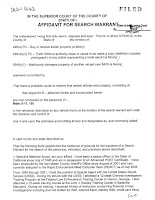
Up until quite recently, there were exceptions to the general requirement that police get a Search Warrant for a cell phone. Cell phones have been a window into suspects’ activities, as police used these exceptions to get their hands on information found inside mobile devices. Obtaining a Search Warrant for a cell phone is not that hard to do. You can review a Search Warrant for a Cell Phone here:  Here is an actual iPhone Search Warrant . GPS or Global Positioning Satellite information found in mobile phones has also been used by police.


Up until around 2014, police could and did search digital information on a cell phone seized from an individual who was arrested. Defense Attorneys would frequently challenge such searches. These searches were frequently based upon “helping” arrested citizens by making sure their property was properly inventoried by the arresting officers for safekeeping by jail personnel or by the evidence unit at the arresting agency’s office. This rationale remains a frequent flier in broad invasive “inventory” searches of automobiles during traffic stops.


Cell Phone Search, Search and Seizure, Search Warrant


Cell Phone Search, Search and Seizure, Search Warrant

Cell Phone Search Warrant

Warrant Required
Mobile Devices
Florida had outlawed warrantless phone searches before the US Supreme Court. That ruling is discussed here. Now prohibited will be mobile device and cell phone searches without a warrant. Before the 2014 United States Supreme Court ruling here was another Court’s Ruling on a Cell Phone Search. Searches Incident to a lawful arrest were previously justified by cops using issues of police officer safety and prevention of destruction of evidence.
Now under Floridalaw, a Motion to Suppress Evidence can be filed pursuant to Rule 3.190(h), Florida Rules of Criminal Procedure. Illegal Search and seizure now applies to cell phones and the Courts may exclude illegally obtained evidence including, photographs, video, text messages, directory and location data, voice mails, and emails.

Case Summary: The US Supreme Court’s ruling is that a properly obtained and issued search warrant is generally required before search of a cell phone. Here is some language from the Court’s ruling.

“Cell phones differ in both a quantitative and a qualitative sense from other objects that might be kept on an arrestee’s person. The term “cell phone” is itself misleading shorthand; many of these devices are in fact minicomputers that also happen to have the capacity to be used as a telephone. They could just as easily be called cameras,video players, rolodexes, calendars, tape recorders, libraries, diaries, albums, televisions, maps, or newspapers.”
“The sum of an individual’s private life can be reconstructed through a thousand photographs labeledwith dates, locations, and descriptions; the same cannot besaid of a photograph or two of loved ones tucked into a wallet.”
“To further complicate the scope of the privacy interests at stake, the data a user views on many modern cell phones may not in fact be stored on the device itself. Treating a cell phone as a container whose contents may be searched incident to an arrest is a bit strained as an initial matter.”
“[T]he search incident to arrest exception does not apply to cell phones . . . .”

Some Excerpts from Florida Cell Phone Search Cases:


“However, we express great concern in permitting the officer to search appellant’s cell phone here where there was no indication the officer had reason to believe the cell phone contained evidence.”
“We are equally concerned that giving officers unbridled discretion to rummage through at will the entire contents of one’s cell phone, even where there is no basis for believing evidence of the crime of arrest will be found on the phone, creates a serious and recurring threat to the privacy of countless individuals.”


Computer Law

Computer Law and Computer Crimes Lawyer in Tampa, Florida

In Tampa, Florida, having a Computer Law and Computer Crimes Lawyer is of paramount importance in today’s digitally driven landscape. These specialized attorneys are equipped to handle legal matters related to technology, data privacy, and cybercrimes. They play a crucial role in assisting individuals and businesses in navigating the complex web of computer laws and regulations.

A Computer Law and Computer Crimes Lawyer in Tampa offers expertise in areas such as intellectual property protection, cybersecurity, data breaches, and digital compliance. They help clients understand their rights and responsibilities in the digital realm, ensuring that they are well-prepared to defend against cybercrimes or pursue legal action when necessary.

With the ever-growing reliance on technology, having a knowledgeable advocate in the field of computer law in Tampa, Florida, is not just an advantage but a necessity for safeguarding one’s digital assets and privacy in an increasingly interconnected world.

crimes computer Tampa Florida Computer Crimes Attorney/Lawyer


Protecting Your Digital World

In an age of digital transformation, the importance of computer law and a computer crimes lawyer cannot be overstated. Our Tampa, Florida-based attorney specializes in defending individuals and businesses against cybercrimes.


Experienced Legal Team

Our attorney has a deep understanding of computer law and is backed by one of the world’s most advanced computer forensic teams. We bring unmatched expertise to safeguard your digital assets and protect your rights.


Comprehensive Legal Services

Whether you’re dealing with data breaches, online fraud, intellectual property disputes, or any computer-related legal issue, our computer crimes lawyer is here to provide the legal guidance and representation you need.

 

crimes computer Tampa Florida Computer Crimes Attorney/Lawyer


Computer Civil Litigation Computer Crimes

Computer Civil Litigation and Computer Crimes are integral components of modern legal practice. Computer Civil Litigation involves legal disputes arising from technology-related issues, encompassing contract breaches, intellectual property disputes, and data privacy violations. It necessitates lawyers with a deep understanding of technology and digital evidence to effectively represent clients.

On the flip side, Computer Crimes involve prosecuting or defending against illegal activities facilitated by computers or the internet. This includes cyberattacks, identity theft, and online fraud. Lawyers specializing in Computer Crimes must stay abreast of evolving cyber threats and digital forensics to combat these offenses.

Together, Computer Civil Litigation and Computer Crimes underscore the growing significance of technology in today’s society. Legal professionals versed in these domains are essential for safeguarding individuals and organizations in an increasingly digital and interconnected world. Their expertise ensures justice in the digital realm and the protection of rights and assets.


Computer Forensics

Computer Forensics is a specialized field within digital investigation that plays a crucial role in solving cybercrimes and uncovering digital evidence for legal purposes. It involves the meticulous examination of digital devices, such as computers, smartphones, and servers, to extract, analyze, and preserve electronic data. Computer Forensic experts use advanced techniques and tools to trace the digital footprints left behind by cybercriminals, recover deleted files, and authenticate electronic evidence.

In today’s technology-driven world, Computer Forensics is invaluable for law enforcement, legal professionals, and organizations. It aids in solving various crimes, from cyberattacks and data breaches to financial fraud and intellectual property theft. It also ensures the integrity of evidence presented in court, facilitating fair trials and the pursuit of justice. As the digital landscape continues to evolve, Computer Forensics remains an essential tool in the fight against cybercrime and the protection of digital assets and privacy.


Intellectual Property Theft

Intellectual Property Theft, often referred to as IP theft, is a grave violation of creators’ and innovators’ rights. It encompasses the unauthorized use, reproduction, or distribution of intellectual property, including patents, trademarks, copyrights, and trade secrets. IP theft can occur in various forms, such as counterfeiting products, plagiarism, software piracy, and corporate espionage.

The consequences of IP theft are far-reaching. It undermines innovation and creativity by discouraging investment in research and development. Businesses suffer financial losses, damaged reputations, and a competitive disadvantage. Moreover, it hampers economic growth and job creation. To combat IP theft, legal systems worldwide provide mechanisms for protecting intellectual property rights, and organizations implement security measures and employee training to safeguard their valuable assets. Vigilance against IP theft is crucial in today’s knowledge-driven economy to foster innovation, protect creators, and maintain a fair marketplace.


Unlawful Access to Networks and/or Data

Unlawful access to networks and/or data, commonly known as hacking, is a serious and pervasive cybercrime in the digital age. It involves unauthorized entry into computer systems, networks, or databases with the intent to steal, manipulate, or compromise sensitive information. These malicious activities can lead to significant harm, including data breaches, financial theft, privacy violations, and even national security threats.

Hackers employ various techniques, from exploiting software vulnerabilities to using phishing schemes, to gain illicit access. Their motivations vary, ranging from financial gain to espionage or ideological purposes. Unlawful access to networks and data poses a substantial risk to individuals, organizations, and governments worldwide.

Preventing such cybercrimes necessitates robust cybersecurity measures, including firewalls, encryption, and employee training on recognizing and mitigating security threats. Legal frameworks and law enforcement efforts are also essential in prosecuting hackers and deterring future unlawful access attempts. In a digitally interconnected world, safeguarding against unauthorized access is crucial for protecting sensitive information and upholding the security and trust of digital ecosystems.

crimes computer Tampa Florida Computer Crimes Attorney/Lawyer

Cell Phone Searches – Supreme Court to Rule on Warrant Requirement

Cell Phone, Cell Phone Search

Cell Phone, Cell Phone Search


Cell Phone Searches – Supreme Court


Update: “Chief Justice John Roberts delivered the opinion of the Court, concluding that a warrant is required to search a mobile phone.[8] Roberts wrote that it fails the warrantless search test established in Chimel v. California.”


“The Supreme Court granted certiorari review in two similar cases, both used with evidence obtained by means of a warrantless search of a cell phone during a lawful arrest.

One friend has said, “Wow, the Supremes are taking a serious look at cell phone searches! There’s been talk for a while now about the problems courts have applying old standard to modern technology.   We may get a sea change in S&S law. Of course, we may not, too, but it’s really worth watching.  If you have a cell phone search case now, for goodness sake make your 4th Am motion and/or objections (track the language in these 2 cases).” Thanks DE for your thoughts on this issue.


In Riley v. California, No. 13-132, a state case, the question presented is:

Whether evidence admitted at petitioner’s trial was obtained in a search of petitioner’s cell phone violated petitioner’s Fourth Amendment rights.

In United States v. Wurie,No. 13-212, the Feds appealed, the question presented is:

Whether the Fourth Amendment permits the police, without obtaining a warrant, to review the call log of a cellphone found on a person who has been lawfully arrested.
 The cases are Riley v. California, No. 13-132, and United States v. Wurie,No. 13-212.

Search Warrant for Cell Phone Handset – Required Florida Supreme Court Says

Cell Phone Search, iPhone Search Warrant, Search warrant

Cell Phone Search, iPhone Search Warrant


Search Warrant for Cell Phone Handset –
Required
Florida Supreme Court Says

Search Warrant for Cell Phone Handset Required


Florida Supreme Court Says a police officer is not authorized to search through photographs and information within a cell phone that was on defendant at time of arrest. Cell phone had been separated from defendant at time of search. Factually, images from defendant’s cell phone depicted a weapon that resembled the gun stolen from convenience store, as well as defendant and his fiancee posing with stolen money packaged in manner described by the victim, a convenience store clerk.
 
Cops in the case properly separated and assumed possession of cell phone from defendantin search incident to arrest. The Florida Supreme Court held a  warrant was required before information, data, and content of cell phone could be accessed and searched by law enforcement.  Notwithstanding decisions of other courts, Conformity clause does not meanFlorida courts must apply U.S. Supreme Court’s holding in United States v. Robinson in this case.
 
The Florida Court reasoned that  Robinson not factually or legally on point. Then in a stunner, the court found that the Good faith exception to exclusionary rule does not apply, since no bright-line rule exists for law enforcement officers to rely upon with regard to searches of electonic devices under facts of this case. 


Cell Phone Search Incident to Arrest

Cell Phone Search Warrant

Cell Phone Search Warrant

Cell Phone Warrantless Search

Cell Phone Searches


Tampa Criminal Defense Attorney / Lawyer continues to follow recent developments in the search of cellular telephones / cell phones. One Florida court has just ruled in a 33 page opinion that pictures in a cell phone obtained from a suspect who had been arrested were inadmissible at trial since they had been seized during a warrantless search.

The court ruled:

“We are equally concerned that giving officers unbridled discretion to rummage through at will the entire contents of one’s cell phone, even where there is no basis for believing evidence of the crime of arrest will be found on the phone, creates a serious and recurring threat to the privacy of countless individuals. Were we free to do so, we would find, given the advancement of technology with regards to cell phones and other similar portable electronic devices, officers may only search cell phones incident to arrest if it is reasonable to believe evidence relevant to the crime of arrest might be found on the phone. Here, there was no evidence the officer had such a reasonable belief.”

“Modern cell phones can contain as much memory as a personal computer and could conceivably contain the entirety of one’s personal photograph collection, home videos, music library, and reading library, as well as calendars, medical information, banking records, instant messaging, text messages, voicemail, call logs, and GPS history. Cell phones are also capable of accessing the internet and are, therefore, capable of accessing information beyond what is stored on the phone’s physical memory. For example, cell phones may also contain web browsing history, emails from work and personal accounts, and applications for accessing Facebook and other social networking sites. Essentially, cell phones can make the entirety of one’s personal life available for perusing by an officer every time someone is arrested for any offense.”

“However, we express great concern in permitting the officer to search appellant’s cell phone here where there was no indication the officer had reason to believe the cell phone contained evidence.”

Cell Phone Search

Defense Attorney on Cell Phone Search | Evidence Suppressed

 Search and Seizure, Motion to Suppress Evidence, Cell Phone, Cell Phone Search, Search incident to arrest, text messages

Search and Seizure, Motion to Suppress Evidence, Cell Phone, Cell Phone Search, Search incident to arrest, text messages

Cell Phone Search Suppressed

Cell Phone Search | Evidence Suppressed


Criminal Defense Attorney / Lawyer notes a recent Cell Phone Search ruling on a Motion to Suppress Evidence, filed pursuant to Rule 3.190(h), Florida Rules of Criminal Procedure. Search and seizure law can apply to cell phones. Lately cops have been searching the phones and calling them a Search incident to arrest. Sometimes cops claim they need to search a phone for the safety of the officer. One court just ruled that a cell phone seized incident to defendant’s arrest posed no risk to officer safety. The scope of a search has been limited, since a cellular telephone is not a container that could hold weapon. Sometimes police justify a search claiming that evidence will be destroyed. A court just ruled that once a phone was seized, there was no longer risk that defendant could destroy evidence in phone. The court concluded that a warrantless search of contents of cell phone was unlawful and a Motion to Suppress was granted.


Cell Phone Search Questions? Call Me Toll Free 1-877-793-9290.


Defense alleged an unlawful search of the Defendant’s cellular telephone including: texts, pictures, the call history, and/or observations made by Officer. Testimony showed cop “found the Defendant’s cell phone while searching his person at the scene, but then later examined the cell phone further at the police station while the Defendant was still being processed. Officer Clark testified that he found text messages regarding the sale of cocaine while he was looking through the Defendant’s phone.”


Cell Phone Court Ruling


Court ruled, “When an officer arrests someone who has a cell phone in their possession, here may very well be reason to suspect that the phone contains valuable information, particularly in drug-related arrests. The call logs and address books could help link a defendant to a particular drug transaction and could provide the identities of other persons involved in the illegal activity; however, these are exactly the types of situations where probable cause could be used to obtain a warrant. The reality is that most information stored on a cell phone will remain there long enough for a warrant to be secured and that numbers “lost” from recent call lists are readily obtainable from the service provider. Cell phones are outside the ambit of the search incident to arrest exception‘s reach because of their capacity for storing vast quantities of intimately personal data. If courts continue to allow the unfettered exploration of this personal data, then courts are permitting the government to execute an unwarranted search of the cell phone user’s life and habits. This intrusion cannot reasonably be justified by the rationales of officer safety and evidence preservation; therefore, a simple seizure of the cell phone must suffice until a warrant can be procured.”

The Court’s Ruling on the Cell Phone Search is Here.


Cell Phone Search Questions? Call Me Toll Free 1-877-793-9290.


Source: FLWSUPP 1805GLAS


Criminal Defense Attorney / Lawyer