Tampa Federal Criminal Defense Attorney Reviews DOJ Memo (Video)

Tweets From The Feds
 

US_Attorney_Discovery_Memo tampa federal criminal defense attorney

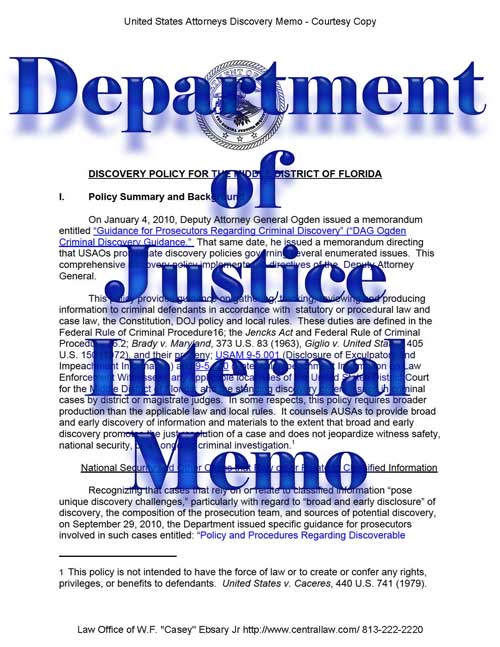
United States Attorneys improperly concealed evidence – the U.S. Department of Justice ordered prosecutors to turn over information to criminal defense lawyers – here are their marching orders courtesy of a Tampa federal criminal defense attorney

Tampa Federal Criminal Defense Attorney notes that tweets are now discoverable in federal criminal cases. Because the Feds (United States Attorneys) were caught hiding evidence, the DOJ (United States Department of Justice) has written a memo on information to provide criminal defense attorneys. After 3 years, the memo has been released. Potential Sources of Discoverable Information include: Agency Files, Confidential Informant Files, Evidence, Gathered Information, Emails, Tweets, Text Messages, Memoranda, and Notes, etc.

Just obtained an internal memo from the Feds discussing all aspects of what the police and prosecutors must disclose to targets of federal prosecutions, including a warning that some tweets and social media use must be disclosed by Prosecutors in criminal cases. In short: Feds were caught hiding the ball and now must follow the rules in this detailed memo.

“tweets are now discoverable”

The new guidelines come from an investigation of case where United States Attorneys ( not in the Middle District of Florida ) were improperly concealing evidence. The memo may have been the result of prosecutors that improperly with held evidence  in the case of a United States Senator who was convicted by a jury. Days later the Justice Department dropped the charges.  After the Senator’s wrongful conviction, to cure these improprieties, the U.S. Department of Justice ordered prosecutors to draft memos on information to provide criminal defense lawyers – here are their marching orders.

Discover tweets: the Feds have

We initially received a tip from the Federal Defender, Eastern District of California. A complete copy of the United States Department of Justice Discovery Memo is available here. A video including the Attorney General’s statements on the problems with handling of evidence and the solution is included at the bottom of this post.

“The biggest problem is that nobody outside the prosecutor’s office actually knows what those policies are.”

The U.S. Department of Justice (USDOJ) ultimately released 73 individualized manuals for many federal district offices. There are links to the other Florida Federal Districts located at the end of this post. Florida has three districts. They are the Middle District, the Southern District, and the Northern District.

The Point: Feds were caught hiding the ball and now must follow the rules in this memo.

In the State court system, most prosecutors have a “open file” policy that ensures that whatever information is contained in the prosecutor’s file is available to defense attorneys. The lone exception has been state cases where police and prosecutors want to protect the identity of confidential sources. In  police reports these frequently appear as “CS” for confidential source or “CI” for confidential informant.

“written and unwritten statements are discoverable in federal criminal cases”


Discovery  Sources Bullet Points

  • Investigative Agency’s Files
  • Confidential Informant Files
  • Evidence and Information Gathered During Investigation
  • Documents or Evidence Gathered by Civil Attorneys
  • Emails, tweets, text messages, memoranda, notes
  • Personnel and Disciplinary Files
  • Handwritten Notes of Agents
  • Presentence Reports

Tampa Federal Criminal Defense Attorney on Discovery Practices


In 20 or so years of Federal Criminal practice in the Tampa Bay area the best course of action considered the fact: “rules for what prosecutors must share and when remained almost entirely secret. . . .” USA Today, filed a Freedom of Information Act request that forced the hand of the Federal Prosecutors to pull back the curtain on what must be provided to defense attorneys under the Constitution and Federal Rules of Criminal Procedure.

“it took the department nearly three years to release the policies”

“The biggest problem is that nobody outside the prosecutor’s office actually knows what those policies are.” said Timothy O’Toole of the National Association of Criminal Defense Lawyers (NACDL). According to USA Today, “it took the department [U.S. Department of Justice] nearly three years to release the policies from 74 U.S. attorneys’ offices . . . .”


Overview of the Federal Prosecutor Manual


Federal Rules of Criminal Procedure Rule 16 (b)


 “Most criminal defense attorneys immediately request that evidence be produced at the initial appearance”

As a starting point, “To trigger the government’s reciprocal discovery rights defined in Federal Rules of Criminal Procedure Rule 16 (b), the defendant must request discovery.” says a footnote in the document. The manual defines the scope of persons including law enforcement agencies and staff from whom investigative information should be obtained.  Most criminal defense attorneys immediately request that evidence be produced at the initial appearance or arraignment or detention hearing. The manual puts in writing the types of information available to defend federal criminal defendant by an exhaustive listing of what constitutes “discovery” or “discoverable information.”

Information Helpful to the Defense


“regardless of whether the prosecutor believes such information will make the difference between conviction and acquittal”

 The memo specifically instructs Assistant United States Attorneys (Prosecutors) that “[a] prosecutor must disclose information that is inconsistent with any element of any crime charged against the defendant or that establishes a recognized affirmative defense, regardless of whether the prosecutor believes such information will make the difference between conviction and acquittal of the defendant for a charged crime.” USAM 9-5.001 C 1.

Limit Use of Reports in Court


 “continue to object to use of the report”

Although the defense may get a report that includes witness statements, the manual reminds prosecutors to limit the use of statements in the reports. Especially when defense attorneys try to use the reports in cross-examination of witnesses in court. The memo states in part, “unless the witness has adopted the memorandum as his statement, AUSAs [Assistant United States Attorneys] should continue to object to use of the report in cross examination as if it were the witness’ statement.” See Page 9 of the Federal Prosecutor’s Memo.

Disclose Written and Unwritten Favorable Information


 “discussions cannot be avoided by failing to memorialize these events”

Sometimes police try to prevent helpful information from falling into the hands of the defense. To that end, the cops would not write down everything. They would fail to include helpful information in their reports. In a most remarkable requirement, the memo reminds prosecutors that, “[t]he duty to disclose to the defendant the substance of what a witness has said during interviews, debriefings, or informal discussions cannot be avoided by failing to memorialize these events. If any such events occur that are not memorialized in an interview report, the AUSA should determine what the witness said during the session and disclose the content of the witness’ statements to the defense. AUSAs should emphasize to agents the importance of memorializing all impeaching information.” See Page 10 of the Federal Prosecutor’s Memo.

The memo also extends prosecutors’ obligation to disclose to preparation of witnesses for trial. “The duty to disclose to the defendant the substance of what a witness has said during a pre-trial preparation session cannot be avoided by failing to memorialize it.” See Page 11 of the Federal Prosecutor’s Memo.

Who is Part of the Prosecution Team?


 “know which agencies have played a role in the investigation”

To prevent prosecutors from using claims that favorable information was not available to disclose, the memo explicitly describes who is a part of the prosecution’s team. “‘prosecution team’ is defined as  including ‘federal, state, and local law enforcement officers and other government officials participating in the investigation and prosecution of the criminal case against the defendant.’ The AUSA needs to know which agencies have played a role in the investigation and make all reasonable inquiries to ascertain what pertinent case information exists. When identifying members of the prosecution team, AUSAs should err on the side of inclusiveness . . . .” See Page 12 of the Federal Prosecutor’s Memo.


Excerpts from the U.S. Attorney’s Manual


Responsibility of AUSA(s)

The responsibility to produce all discoverable information in a criminal case lies with the AUSA(s) assigned to the case. To fulfill this responsibility, AUSAs should consider several matters:

• What & When: What are the policies, rules, statutes and case law that define what must be produced and when must it be produced? (See II. Laws, Rules and Policy Governing the Production of Discoverable
Information (What Must Be Produced and When?))

• Who is part of the prosecution team: AUSAs are obligated to produce information that is within the possession of the prosecution team; thus, defining the scope of the prosecution team is critical. (See III. Who is Part of the Prosecution Team: Gathering and Reviewing Potentially Discoverable Information)

• Where to look: Once the prosecution team has been identified, AUSAs must ensure that all discoverable information is located, reviewed and produced as required, including agency investigative and administrative files, CI files, emails, PSRs, law enforcement Giglio, etc. (See IV. Potential Sources of Discoverable Information)

• How to produce and track: AUSAs must decide in what form to produce the discovery (bates numbered, hard copy, e-copy, available for inspection, redacted, etc), and must keep a detailed record of all discovery produced. (See V. Manner of Production and Recordkeeping) See Page 2 of the Federal Prosecutor’s Memo.

Scope of Criminal Discovery in Federal Cases

“For the purposes of this memorandum, “discovery” or “discoverable information” is not limited to Federal Rule of Criminal Procedure 16 information, but also includes all information and materials the
government must disclose to the defendant pursuant to the Jencks Act and Federal Rule of Criminal Procedure 26.2; Federal Rule of Evidence 404(b); Brady, Giglio, USAM 9-5.001 and 9-5.100; any applicable local rules; and the any applicable standing discovery order in a criminal case.” See Page 3 of the Federal Prosecutor’s Memo.

Memo Policies Must be Followed

“Deviation from the policy of production of reports of witness interviews requires Criminal Chief or Deputy Criminal Chief approval.” See Page 9 of the Federal Prosecutor’s Memo.

Not All Witness Statements are Created Equal

“Be careful not to characterize a witness interview as a Jencks Act statement in discovery letters or court pleadings”

“The Jencks Act defines “witness statements” as … “(1) a written statement made by [a] witness and signed or otherwise adopted or approved by him; (2) a stenographic, mechanical, electrical, or other recording, or a transcription thereof, which is a substantially verbatim recital of an oral statement made by [the] witness and recorded contemporaneously with the making of such oral statement; or (3) a statement, however taken or recorded, or a transcription thereof, if any, made by [a] witness to a grand jury.” 18 U.S.C. § 3500 (e).

“[U]nless the witness has adopted the memorandum as his statement, AUSAs should continue to object to use of the report in cross examination as if it were the witness’ statement.”  See Page 9 of the Federal Prosecutor’s Memo.

Helpful Information Must be Disclosed – Written or Not

“Memorializing Favorable Information and the Duty to Disclose. The duty to disclose to the defendant the substance of what a witness has said during interviews, debriefings, or informal discussions cannot be avoided by failing to memorialize these events. If any such events occur that are not memorialized in an interview report, the AUSA should determine what the witness said during the session and disclose the content of the witness’ statements to the defense. AUSAs should emphasize to agents the importance of memorializing all impeaching information.” See Page 10 of the Federal Prosecutor’s Memo. (underlining in original).

Witness Interview and Preparation – Continuing Duty to Disclose

“The duty to disclose to the defendant the substance of what a witness has said during a pre-trial preparation session cannot be avoided by failing to memorialize it.” See Page 11 of the Federal Prosecutor’s Memo.


Video – Attorney General Holder on the Discovery Memo


Other Florida Federal District Court Discovery Manuals


Florida – Northern District

Florida – Southern District

Sources:
https://www.usatoday.com/story/news/2015/03/03/justice-department-discovery-policies-released/24239225/
https://www.justice.gov/dag/memorandum-heads-department-litigating-components-handling-criminal-matters-all-united-states


Questions on Tampa Federal Criminal Issues?

Call Us 24/7/365 (813) 222-2220

Law Office of W.F. ''Casey'' Ebsary Jr

2102 W Cleveland St
Tampa, FL 33606
US

Fax: (813) 225-0202

Email: centrallaw@centrallaw.com

Map and Directions

Deportation of Cuban Nationals From United States

Cuba, Deportation, lawful permanent resident, ICE, LPR
Deportation of Cuban Nationals

Deportation of Cuban Nationals From the United States remains an open question for Federal Criminal Defense Attorneys in United States District Courts. One source says, “At this point we do not know how/when the normalization will impact the U.S.’s ability to deport Cuban individuals.  At any rate, those who are in lawful status and not subject to any grounds of deportation (i.e. those who entered, obtained lawful permanent resident status, and do not have crimes that make them deportable) do not need to worry.  The main impact will be on those who either fell out of status and can’t fix their status now (for example, those who were paroled in and then never applied for lawful permanent resident status, and who are not eligible for LPR status due to crimes) and those who already have deportation orders but were released from ICE custody on ICE orders of supervision because they could not be physically deported.”

UPDATE – Deportation of Cuban Nationals


“The notice includes a warning: 

If you do not appear at a hearing, 
you may be ordered deported in your absence.”


Notice of Hearing, Cuba, Deportation, ICE, lawful permanent resident, LPR
Sample Notice of Hearing

There is at least one case where the deportation proceedings of a Cuban national was reset to 2019, almost four years after the initial notice from the Immigration Court. A sample Notice of Hearing is included in this article. The notice includes a warning that “If you do not appear at a hearing, you may be ordered deported in your absence.”

Furthermore the source advises, “At this point, I think it’s important to advise Cuban clients that deportation may be a reality soon and that they should be careful to avoid criminal activity and pleading to offenses that will bring them to ICE’s attention/subject them to criminal grounds of deportation.  Basically, after years of not having to face full immigration consequences (physical deportation) of criminal convictions, they will now have to seriously consider those consequences.”
Contribute to NIJC and provide critical legal services to families in the coming year!

Wiretaps in Federal Prosecutions | Florida

Wiretaps - An Overview of Federal Statutes Governing Wiretapping and Electronic Eavesdropping

Wiretaps

Wiretaps in Federal Prosecutions

A friend at the Federal Defender’s Office in Florida just sent us this information on Wiretaps in Federal Prosecution and  provided us with a new Congressional Research Service report entitled “Privacy: An Overview of Federal Statutes Governing Wiretapping and Electronic Eavesdropping.” It is comprehensive and should be useful to anyone with a case in which wiretaps are an issue. Some excerpts are below and a download of the complete document is available below.:


“Unless otherwise provided, Title III/ECPA outlaws wiretapping and electronic eavesdropping; possession of wiretapping or electronic eavesdropping equipment; use or disclosure of information obtained through illegal wiretapping or electronic eavesdropping; and disclosure of information secured through court-ordered wiretapping or electronic eavesdropping, in order to obstruct justice, 18 U.S.C. 2511. Elsewhere, federal law proscribes:
  • unlawful access to stored communications, 18 U.S.C. 2701;
  • unlawful use of a pen register or a trap and trace device, 18 U.S.C. 3121; and
  • abuse of eavesdropping and search authority or unlawful disclosures under the Foreign Intelligence Surveillance Act, 50 U.S.C. 1809, 1827.”

The report summarizes:

“At the heart of Title III/ECPA lies the prohibition against illegal wiretapping and electronic eavesdropping, 18 U.S.C. 2511(1), that bans:

  • any person from
  • intentionally
  • intercepting, or endeavoring to intercept,
  • wire, oral or electronic communications
  • by using an electronic, mechanical or other device
  • unless the conduct is specifically authorized or expressly not covered, e.g. one of the parties to the conversation has consent to the interception
  • the interception occurs in compliance with a statutorily authorized, (and ordinarily judicially supervised) law enforcement or foreign intelligence gathering interception,
  • the interception occurs as part of providing or regulating communication services,
  • certain radio broadcasts, and in some places, spousal wiretappers.”

The complete report is available here,

History of Cell Phone Searches

Cell Phone Search Warrant

Cell Phone Search Warrant, Cell Phone Search, Search and Seizure

Search Warrant
Cell Phone

Cell Phone Search Warrant


Up until quite recently, there were exceptions to the general requirement that police get a Search Warrant for a cell phone. Cell phones have been a window into suspects’ activities, as police used these exceptions to get their hands on information found inside mobile devices. Obtaining a Search Warrant for a cell phone is not that hard to do. You can review a Search Warrant for a Cell Phone here:  Here is an actual iPhone Search Warrant . GPS or Global Positioning Satellite information found in mobile phones has also been used by police.


Up until around 2014, police could and did search digital information on a cell phone seized from an individual who was arrested. Defense Attorneys would frequently challenge such searches. These searches were frequently based upon “helping” arrested citizens by making sure their property was properly inventoried by the arresting officers for safekeeping by jail personnel or by the evidence unit at the arresting agency’s office. This rationale remains a frequent flier in broad invasive “inventory” searches of automobiles during traffic stops.


Cell Phone Search, Search and Seizure, Search Warrant


Cell Phone Search, Search and Seizure, Search Warrant

Cell Phone Search Warrant

Warrant Required
Mobile Devices
Florida had outlawed warrantless phone searches before the US Supreme Court. That ruling is discussed here. Now prohibited will be mobile device and cell phone searches without a warrant. Before the 2014 United States Supreme Court ruling here was another Court’s Ruling on a Cell Phone Search. Searches Incident to a lawful arrest were previously justified by cops using issues of police officer safety and prevention of destruction of evidence.
Now under Floridalaw, a Motion to Suppress Evidence can be filed pursuant to Rule 3.190(h), Florida Rules of Criminal Procedure. Illegal Search and seizure now applies to cell phones and the Courts may exclude illegally obtained evidence including, photographs, video, text messages, directory and location data, voice mails, and emails.

Case Summary: The US Supreme Court’s ruling is that a properly obtained and issued search warrant is generally required before search of a cell phone. Here is some language from the Court’s ruling.

“Cell phones differ in both a quantitative and a qualitative sense from other objects that might be kept on an arrestee’s person. The term “cell phone” is itself misleading shorthand; many of these devices are in fact minicomputers that also happen to have the capacity to be used as a telephone. They could just as easily be called cameras,video players, rolodexes, calendars, tape recorders, libraries, diaries, albums, televisions, maps, or newspapers.”
“The sum of an individual’s private life can be reconstructed through a thousand photographs labeledwith dates, locations, and descriptions; the same cannot besaid of a photograph or two of loved ones tucked into a wallet.”
“To further complicate the scope of the privacy interests at stake, the data a user views on many modern cell phones may not in fact be stored on the device itself. Treating a cell phone as a container whose contents may be searched incident to an arrest is a bit strained as an initial matter.”
“[T]he search incident to arrest exception does not apply to cell phones . . . .”

Some Excerpts from Florida Cell Phone Search Cases:


“However, we express great concern in permitting the officer to search appellant’s cell phone here where there was no indication the officer had reason to believe the cell phone contained evidence.”
“We are equally concerned that giving officers unbridled discretion to rummage through at will the entire contents of one’s cell phone, even where there is no basis for believing evidence of the crime of arrest will be found on the phone, creates a serious and recurring threat to the privacy of countless individuals.”


How to Forfeit Most of your Assets in Federal Court in 10 Easy Steps?

How to Forfeit Most of your Assets in Federal Court in 10 Easy Steps?

How to Forfeit Most of your Assets in Federal Court in 10 Easy Steps?

Many forfeitures of assets to the Federal Government are conditions included in standard plea agreements to criminal charges in the Middle District of Florida Tampa Division. So some have asked: How can someone Forfeit Most of their Assets in Federal Court? Let me walk you through an actual case we reviewed in Tampa. I did not represent this now broke person who now lives in a Federal Prison.

Ironically, after agreeing to give up everything he owned, the defendant filed a claim in Federal Court trying to retrieve his money, other assets and a rather nice Bentley automobile. Good luck with that claim. Here is how to lose all of your stuff through an agreement with the Federal Government.

How to lose everything in a Federal Forfeiture Case in 10 Easy Steps?

  1. Commit and plead to a federal indictment that includes forfeiture provisions that usually read like this: The defendant agrees to forfeit to the United States immediately and voluntarily any and all assets and property, or portions thereof, subject to forfeiture, pursuant to Title 18, United States Code, Sections 981(a)(l)(C) and Title 28, United States Code, Section 2461(c), whether in the possession or control of the United States or in the possession or control of the defendant or defendant’s nominees. The assets to be forfeited specifically include, but are not limited to, the following: a forfeiture money judgment of at least $1,176,787.00. representing the total amount.
  2. Have a list like this one included in your plea agreement: “Items Seized from the Defendant Approximately $118,275.00 stored on 143 Green Dot and Wal-Mart Money cards; 2005 Bentley GT, Baranato Green, VIN SCBCR63W25C026307; 18 Karat Gold Rolex Oyster Perpetual Day Date Watch with a Diamond Dial; 14 Karat Gold Necklace with “RS’Pendant with 703 Diamonds; 14 Karat Gold Double Cuban Link Chrome Chain; 14 Karat Gold Men’s Ring with 1 10 Diamonds; 14 Karat Gold and Diamond Men’s Bracelet with 2,420 Round Diamonds; 14 Karat Gold Men’s Square Ring with 54 Round Diamonds; KC Stainless Steel Men’s Watch with 57 Diamonds; KC Stainless Steel Men’s Watch with 33 Diamonds; and approximately $25,000.00 in U.S. Currency; approximately $22,580 in U.S. Currency.
  3. Agree and Consent to the following: defendant “agrees and consents to the forfeiture of these assets pursuant to any federal criminal, civil, andfor administrative forfeiture action. The defendant also hereby agrees that the forfeiture described herein is not excessive and, in any event, the defendant waives any constitutional claims that the defendant may have that the forfeiture constitutes an excessive fine.
  4. Agree that the property is related to the offense charged: “The defendant admits and agrees that the conduct described in the Factual Basis below provides a sufficient factual and statutory basis for the forfeiture of the property sought by the government. Pursuant to the provisions of Rule 32.2(b)(l), the United States and the defendant request that at the time of accepting this ptea agreement, the court make a determination that the government has established the requisite nexus between the property subject to forfeiture and the offense(s) to which defendant is pleading guilty and enter a preliminary order of forfeiture. Pursuant to Rule 32.2(b)(4), the defendant agrees that the preliminary order of forfeiture shall be final as to the defendant at the time it is entered, notwithstanding the requirement that it be made a part of the sentence and be included in the judgment.
  5. Agree to help the feds find all of your stuff: “Defendant further agrees to take all steps necessary to locate property and to pass title to the United States before the defendant’s sentencing. To that end, defendant agrees to fully assist the government in the recovery and return to the United States of any assets, or portions thereof, as described above wherever located. The defendant agrees to make a full and complete disclosure of all assets over which defendant exercises control and those which are held or controlled by a nominee. The defendant further agrees to be polygraphed on the issue of assets, if it is deemed necessary….”
  6. Agree that the feds can go after other stuff too: ” The defendant agrees that the United States is not limited to forfeiture of the property described above. If the United States determines that property of the defendant identified for forfeiture cannot be located upon the exercise of due diligence; has been transferred or sold to, or deposited with, a third party; has been placed beyond the jurisdiction of the Court; has been substantially diminished in value; or has been commingled with other property which cannot be divided without difficulty; then the United States shall, at its option, be entitled to forfeiture of any other property (substitute assets) of the defendant.
  7. Agree to the Facts of the case like this: “Defendant is pleading guilty because defendant is in fact guilty. The defendant certifies that defendant does hereby admit that the facts set forth below are true, and were this case to go to trial, the United States would be able to prove those specific facts and others beyond a reasonable doubt: . . . From at least in or about March 201 1, through the present, [The Defendant who was Indicted], in part through his car dealership known as “[Name of your Business here],” engaged in a scheme and artifice to defraud the U.S. Treasury Department, commonly known as “Turbo Tax Fraud,” by filing fraudulent income tax returns and negotiating fraudulent federal income tax refunds. During the summer of 2011, law enforcement received multiple tips that [Defendant who was charged with a federal Crime] was engaging in tax fraud at his business, [Your Business Name Here]. The sources stated that [Soon to be Broke Defendant who agreed to all this] sold automobiles to buyers who paid him with United States Treasury checks obtained from the filing of fraudulent federal income tax returns. The sources advised that the fraudulently obtained Treasury checks [Name Deleted} received were for a much higher value than the sales price of the vehicles sold. Simmons then negotiated the checks and laundered the proceeds through his business accounts. Sources also stated that [defendant] filed fraudulent tax returns from his computer located at his business, . . .  and maintained a ledger that contained numerous personal identifiers associated with the filing of fraudulent tax returns such as names, dates of birth, and social security numbers of identity theft victims. The sources  further stated that Simmons would frequently possess multiple Treasury checks or prepaid debit cards in names other than his own and would place the proceeds from the negotiated checks and debit cards into his business account(s).
  8. Have your Buddy Cooperate with the Feds Like This: “On or about July 12,201 1, a cooperating defendant (CD) wearing a concealed digital audio recorder traveled to …the Middle District of Florida, and met . . advised the CD to bring him . . . Green Dot cards and he would take care of the rest.”
  9. Get videotaped in your scheme; “Surveillance video captured . . .  using a pre-paid debit card [and  on another date] captured on video .  . . making an ATM withdrawal using the card [and then] was captured on video using a money machine at at 1208 East Brandon Blvd, Brandon, in the Middle District of Florida.”
  10. Have Zero Chance of Getting Your Stuff Back Later.
Sources: 
 
Federal Court Documents

Foreign Corrupt Practices Act

Foreign Corrupt Practices Act

Foreign Corrupt Practices Act

Foreign Corrupt Practices Act (FCPA)

What is the Foreign Corrupt Practices Act? Indictment charging criminal violations of the FCPA.

For those of you unfamiliar with the Foreign Corrupt Practices Act (FCPA), if may be time to get acquainted.

The FCPA, found at Title 15 U.S. Code Section 78dd, prohibits “bribes” to any individual working in the executive, legislative, or judicial branch of a foreign government in order to obtain or retain business. For years, business was done in certain foreign countries under a “pay to play” scenario- someone needed to get paid in order to get the deal done. Most often, when these arrangements were detected, the Department of Justice imposed civil fines and penalties and permitted the American company and its employees to keep doing business. That trend seems to have ended.
The DOJ and FBI have recently ramped up criminal enforcement of this law. Entire FBI squads as well as teams of DOJ lawyers are now assigned, full time, to identifying criminal violations and prosecuting alleged violators, individuals and companies. In addition to our very recent case in DC, on May 10, 2011, the government obtained convictions of Lindsey Manufacturing and two of its executives on charges of Conspiracy to violate the FCPA, arising out of an scheme to bribe Mexicans officials. Another criminal FCPA trial against employees of a California company, alleging bribes to a Chinese officials, will begin soon in Los Angeles. Do not think that these cases are limited to Fortune 500 companies and their employees- my client owned a mid-sized police equipment supply company in St. Petersburg . I must admit that I did not realize the full scope of the government’s efforts in this area until becoming involved in this case.
What happened in my case? After 9 weeks of trial and 6 days of deliberations, a mistrial was declared when the jury was unable to reach a verdict. They were hung 9-2 with one undecided for acquittal on the conspiracy, but closer on the substantive counts. We had raised many defenses available under the FCPA, including lack of business nexus between the payment and the contract, and absence of mens rea – the statute requires the government to prove both willfulness and corrupt intent. We also attacked, successfully, I believe, the method and integrity of the FBI’s investigation.
The bottom line here is that all clients and companies doing business with foreign governments must be made aware of this law. Although “bribes” are illegal, there are permissible ways to compensate foreign agents and foreign officials under limited circumstances. It is important to recognize the difference. Look for a lot more of these cases in the future.
Special Thanks to Guest Author.

What is Entrapment?

What is Entrapment?
Sometimes law enforcement behavior can be so despicable that their conduct and method of investigation leads only to entrapped citizens. This form of entrapment is rare but not unheard of.

What is Entrapment?


Entrapment occurs when criminal conduct is a product of law enforcement officials. In other words, a police officer can’t lure an innocent person to commit a crime then arrest them for it. When cops cross this boundary the defense of entrapment is available.


Florida Laws on Entrapment


Florida recognizes two theories of defense based on entrapment: subjective and objective entrapment. See 777.201, Florida Statutes; Munoz v. State, 629 So. 2d 90, 99 (Fla. 1993). Subjective entrapment focuses on whether conduct by law enforcement induced, encouraged, or caused the defendant to commit a crime when he or she was not predisposed to do so. See § 777.201, Fla. Stat.; Jones v. State, 114 So. 3d 1123, 1126 (Fla. 1st DCA 2013).


Subjective Entrapment


The test to establish a subjective entrapment defense includes:

1. whether a government agent induced the defendant to commit the crime charged;

Inducement has been defined as “any government conduct creating a substantial risk that an otherwise law-abiding citizen would commit an offense, including persuasion, fraudulent representations, threats, coercive tactics, harassment, promises of reward, or pleas based on need, sympathy or friendship” Farley v. State, 848 So. 2d 393 (Fla. 4th DCA 2003).

2. whether the defendant was predisposed to commit the crime charged;

Predisposition asks whether the accused was awaiting any propitious opportunity or was ready and willing, without persuasion, to commit the offense. Munoz, 629 So. 2d at 99. Predisposition is not present when one has no prior criminal history related to the offense at issue. Nadeau v. State, 683 So. 2d 504, 506 (Fla. 4th DCA 1995).

(3) whether the entrapment defense should be evaluated by the jury.

Where the facts and the law establish entrapment there is no need for the jury to make any findings of fact. Where facts are contested though the issue of entrapment will be decided by a jury.


Objective Entrapment


Objective entrapment occurs when egregious law enforcement conduct amounts to a violation of the defendant’s right to due process under article I, section 9, of the Florida Constitution. See Munoz, 629 So. 2d at 99.

Simply put, law enforcement behavior can be so despicable that their conduct and method of investigation leads only to entrapped citizens. This form of entrapment is rare but not unheard of.

Thanks to Guest Author Robson Powers of the Law Office of Michael P. Maddux, P.A.


Pasco Oxycodone Defense Attorney – 813-222-2220 – Video on YouTube

Pasco Oxycodone Defense Attorney

Pasco Oxycodone Defense Attorney


Pasco Oxycodone Defense Attorney has a FREE fully searchable Pasco Drug Crimes Oxycodone defense database on Oxycontin and drug charges in Florida. Drug Crimes Data Base Click Here. This video discusses and Compares How to use probable cause in criminal cases and the possibility of drug charges being dropped or dismissed when police improperly search for and then seize contraband. Casey reviews the Minimum Mandatory sentences that may apply to some Drug Trafficking cases. W.F. “Casey” Ebsary, Jr. is a Board Certified Criminal Trial Attorney, a specialist who defends drug crimes in Pasco County, Florida.


Transcript: [Pasco Oxycodone Defense Attorney Narrates] Hundreds of people are arrested every day. You may be one of them. I spend most of my time defending cases in State and Federal Courts. Many times drug crimes arise from searches of motor vehicles. Sometimes police will stop a car and then search it. Sometimes we are able to attack these searches when police do not have reasonable suspicion or probable cause to search the motor vehicle. In the event we can suppress the evidence, we may be able to have the drug charges dismissed, since there is no longer any evidence to be admitted against you in a criminal prosecution and evidence becomes unavailable for admission in a trial. I have arrived at my destination – one of the many courthouses in Tampa Bay where I help people. Let me help you. Criminal charges in State or federal Court? Let me help. Call me at 813-222-2220. Let me drive to court to help you.[End of Pasco Oxycontin Defense Lawyer Narration]

Polk Marijuana Defense Attorney 813-222-2220 – Drug Crimes – Cannabis

Polk County Marijuana Law

Polk County Marijuana Law


Drug2Go.com and Polk Marijuana Defense Attorney now have a FREE fully searchable Polk Drug Crimes Cannabis Marijuana defense database on marijuana and drug charges in Florida. This video discusses and Compares How to use probable cause in criminal cases and the possibility of drug charges being dropped or dismissed when police illegally improperly search for and then seize contraband without a Search Warrant. Casey reviews the Minimum Mandatory sentences that may apply to some Marijuana and Cannabis Drug Trafficking cases. W.F. “Casey” Ebsary, Jr. is a Board Certified Criminal Trial Attorney, a specialist who defends drug crimes in Polk County, Florida.


Transcript: [Polk Marijuana Defense Attorney Narrates] Hundreds of people are arrested every day. You may be one of them. I spend most of my time defending cases in State and Federal Courts. Many times drug crimes arise from searches of motor vehicles. Sometimes police will stop a car and then search it. Sometimes we are able to attack these searches when police do not have reasonable suspicion or probable cause to search the motor vehicle. In the event we can suppress the evidence, we may be able to have the drug charges dismissed, since there is no longer any evidence to be admitted against you in a criminal prosecution and evidence becomes unavailable for admission in a trial. I have arrived at my destination – one of the many courthouses in Tampa Bay where I help people. Let me help you. Criminal charges in State or federal Court? Let me help. Call me at 813-222-2220. Let me drive to court to help you.[End of Polk Cannabis Defense Lawyer Narration]

Boston Marathon Bombing Criminal Complaint Download PDF Here

Boston Marathon Bombing Criminal Complaint is available here:

https://centrallaw.com/BostonMarathonBombingCriminalComplaintTsarnaev.pdf


Excerpts from Special Agent’s Affidavit:


bombing, Criminal Complaint Boston Marathon, terrorism, United States District Court,

Criminal Complaint Boston Marathon,

Boston Marathon Bombing
Criminal Complaint
Download PDF Here

“I submit this affidavit in support of an application for a complaint charging DZHOKHAR TSARNAEV with (1) unlawfully using and conspiring to use a weapon of mass destruction (namely, an improvised explosive device) against persons and property within the United States …”


“I have reviewed videotape footage taken from a seculity camcra located on Boylston Street near the corner of Boylston and Gloucester Streets. At approximately 2:38 p.m. (based on the video’s duration and timing of the explosions) — i.e., approximately 1 I minutes before the first explosion –two young men can be seen turning left (eastward) onto Uoylsion from Gloucester Street. Both men are carrying large knapsacks.”


“Approximately 30 seconds before the first explosion, he lifts his phone to his ear as if he is speaking on his cell phone, and keeps it there for approximately 18 seconds. A few seconds afler he finishes the call, the large crowd of people around him can be seen reacting to the first explosion. Virtually every head turns to the east (towards the finish line) and stares in that direction in apparent bewilderment and alarm. Bomber
Two, virtually alone among the individuals in front of’the restaurant, appears calm.”


“In addition, from the scene of the shootout on Laurel Street in Watertown, the FBI has recovered two unexploded IEDs, as well as the remnants of numerous exploded IEDs.”
“The remnants of at least one of the exploded IEDs at the scene of the shootout indicate that a low-grade explosive had been contained in a pressure cooker. The pressure cooker was of the same brand as the ones used in the Marathon explosions. The explosive also contained metallic BBs contained within an adhesive material as well as green-colored hobby fuse. The intact low-grade explosive device found in the abandoned car was in a plastic container and wrapped with green-colored hobby fuse.”

“On April 21, 2013, the FBI searched DZHOKHAR TSARNAEV’s dormitory room at 7341 Pine Dale Hall at the University of Massachusetts at Dartmouth, pursuant to a search warrant. The FBI seized from his room, among other things, a large pyrotechnic, a black jacket and a white hat of the same general  appearance as those worn by Bomber Two at the Boston Marathon on April 15, 2013, and BBs.”

“Based on the foregoing, there is probable cause to believe that on or about April 15, 2013, DZHOKHAR TSARNAEV violated 18 U.S.C. $5 2332a (using and conspiring to use a weapon of mass destruction, resulting in death) and 844(i) (malicious destruction of property by means of an explosive devicc, resulting in death). Accordingly, I respectfully request that the Court issue a complaint charging DZHOKHAR  TSARNAEV with those crimes. Special Agent
Federal Bureau of Investigation”