Jury Selection | Juror Questionnaires | Barry Bonds

Juror Questionaire, Jury Selection, Jurors

Juror Questionaire, Jury Selection, Jurors

Juror Questionnaires

Questions for Potential Jurors


“jury decision should be based upon the evidence in court, trial lawyers want to know if prospective jurors have been following a case in the media”


Defense Attorneys who go to trial would like to know more about those who are seated on a jury in their client’s trials. In a jury trial dozens of people are called by the court and interviewed by the lawyers and in some case, by the judge. Some trial courts allow for written questions to be answered by potential jurors to aid in the selection process. I have spent some time reviewing a juror questionnaire in a high profile trial in federal court and listed a few questions below. Our readers can view a recent Federal Juror Questionnaire here. We have also posted a Juror Questionnaire used in an entertainment personality’s trial here.


Since a jury decision should be based upon the evidence in court, trial lawyers want to know if prospective jurors have been following a case in the media. Now that means television, radio, newspapers, and the internet.

31. How often do you use the Internet?
( ) Never ( ) A little ( ) Sometimes ( ) A lot ( ) Every day
What sort of things do you use the Internet for?
What sort of information do you obtain from the Internet?
Which web sites do you visit regularly?
32. Do you like to “blog” or read blogs on the Internet? ( ) Yes ( ) No
IF YES, which blogs do you visit?
33. Do write your own blog or post comments on other blogs? ( ) Yes ( ) No
IF YES, what is the name of your blog or what blogs do you post comments to?
47. Reports about this case have appeared in the news. Have you seen, heard or read anything about this case? (This includes not only anything you may have seen or read in the media, but also anything you might have heard from relatives, friends or coworkers.)
( ) Yes ( ) No
IF YES, please indicate where you heard or read about this case by checking all that apply:
( ) TV News ( ) Radio News ( ) Newspaper ( ) Magazines ( ) Books, including “Game of Shadows”( ) Internet ( ) On-Line ( ) Conversations ( ) Overheard others discussing the case
Will there be a Jury Selected in Your Case? Call for a Free Telephone Consultation 1-877-793-9290.

Spring Break High Tech Mobile Arrest | Florida Update

Cops and Businesses Monitor Visitors

Spring Break Update | Criminal Defense Expert,  notes that some police agencies are employing mobile 3G and WiFi ID Card Scanners,  and a non-discretionary “zero tolerance” policy to encountering and arresting Spring Break visitors. Police are using fairly vague and discretionary charges, such as Disorderly Conduct Florida Statute 877.03. These seemingly minor charges can result in a permanent criminal record. See details about this charge below.

Also we note that one restaurant on a beach has over a dozen security cameras monitoring the activities of beach-goers. One media outlet predicted, “more than 2 million students will be on break.” BayNews9.com . With the foolishness of zero-tolerance policies we expect Florida Courts and jails to be packed. Casey frequently represents out-of-state visitors charged with offenses while on vacation.

For Help Call 1-877-793-9290


Security Cameras

One small Florida police department has even installed a couple of cameras mounted on utility poles to monitor beach visitors. Expect that law enforcement will also be using readily available portable card scanners that will retrieve age information from the back of Florida (and possibly other) state driver’s licenses.

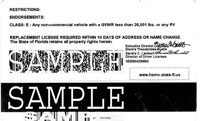
Back of Florida License

According to official sources with the State of Florida, “The (Florida License and ID Cards) cards are created using a new, updated digital imaging process. This process stores all the information from the front of the card in a 2-D barcode and magnetic stripe located on the back (see photo to your left). Driver license class, restrictions, conditions, and endorsements specific to the driver are printed on the back.” DHSMV Official Site.

For Help Call 1-877-793-9290


Disorderly Conduct | Summary of Charge

Florida Statute: 877.03
Level: 2nd Degree Misdemeanor

Breach of the peace; disorderly conduct.

Whoever commits such acts as are of a nature to corrupt the public morals, or outrage the sense of public decency, or affect the peace and quiet of persons who may witness them, or engages in brawling or fighting, or engages in such conduct as to constitute a breach of the peace or disorderly conduct, shall be guilty of a misdemeanor of the second degree, punishable as provided in s. 775.082 or s. 775.083.

For Help Call 1-877-793-9290

Underage Drinking | Open Container | Summary of the Charges

Many Florida Communities have very stringent Open Container Laws that prohibit possession of open containers away from licensed facilities (Bars) and particularly on some beaches. Below are details of one such ordinance.

Sample Open Container Ordinance

Tampa Open Container Ordinance Sec. 3-40. – Consumption and possession of open containers on streets, sidewalks, alleys and other public property.
(a)It is unlawful for any person to consume, assist or aid another to consume any alcoholic beverage upon any street, sidewalk, alley or other public property within the city.
(b)It is unlawful for any person to possess an open container of an alcoholic beverage upon any street, sidewalk, alley or other public property, including public or semi-public parking lots, within the city.
(1)As used in subsection (b), “open container” means any vessel or container containing an alcoholic beverage, including beer or wine, which is immediately capable of consumption or the seal of which has been broken.
(2)An open container shall be considered to be in the possession of the person if the container is in the physical control of such person.
(c)Subsections (a) and (b) do not apply when:
(1)The street, connecting sidewalk or alley has been officially temporarily closed upon application to the director of public works and the approval of the city council for the purpose of a block party as provided in this Code; or
(2)A portion of a sidewalk has been leased and permitted as a sidewalk café as provided for in chapter 22 of this Code; or
(3)Public property has been zoned and permitted for the sale of alcoholic beverages pursuant to law; or
(4)A portion of the street, connecting sidewalk or alley has been marked and/or designated as a crossing for a public golf course.
For Help Call 1-877-793-9290
Florida Underage Drinking Statute
562.111 Possession of alcoholic beverages by persons under age 21 prohibited.
(1) It is unlawful for any person under the age of 21 years, except a person employed under the provisions of s. 562.13 acting in the scope of her or his employment, to have in her or his possession alcoholic beverages, except that nothing contained in this subsection shall preclude the employment of any person 18 years of age or older in the sale, preparation, or service of alcoholic beverages in licensed premises in any establishment licensed by the Division of Alcoholic Beverages and Tobacco or the Division of Hotels and Restaurants. Notwithstanding the provisions of s. 562.45, any person under the age of 21 who is convicted of a violation of this subsection is guilty of a misdemeanor of the second degree, punishable as provided in s. 775.082 or s. 775.083; however, any person under the age of 21 who has been convicted of a violation of this subsection and who is thereafter convicted of a further violation of this subsection is, upon conviction of the further offense, guilty of a misdemeanor of the first degree, punishable as provided in s. 775.082 or s. 775.083.
(2) The prohibition in this section against the possession of alcoholic beverages does not apply to the tasting of alcoholic beverages by a student who is at least 18 years of age, who is tasting the alcoholic beverages as part of the student’s required curriculum at a postsecondary educational institution that is institutionally accredited by an agency recognized by the United States Department of Education and that is licensed or exempt from licensure pursuant to the provisions of chapter 1005 or is a public postsecondary education institution; if the student is enrolled in the college and is tasting the alcoholic beverages only for instructional purposes during classes that are part of such a curriculum; if the student is allowed only to taste, but not consume or imbibe, the alcoholic beverages; and if the alcoholic beverages at all times remain in the possession and control of authorized instructional personnel of the college who are 21 years of age or older.
(3) In addition to any other penalty imposed for a violation of subsection (1), the court shall direct the Department of Highway Safety and Motor Vehicles to withhold issuance of, or suspend or revoke, the violator’s driver’s license or driving privilege, as provided in s. 322.056.
For Help Call 1-877-793-9290

Source: https://www.baynews9.com/article/news/2011/march/215091/Police-cracking-down-during-spring-break
https://www.flhsmv.gov/ddl/newformat.html

Tampa Police Arrest 2011 Gasparilla Video

Tampa Criminal Defense Attorney / Lawyer, Casey Ebsary, found this internet Video produced by the Tampa Police Department. We have been working through the night helping those who were charged at this year’s Gasparilla Pirate Fest in Tampa, Florida  near Bayshore Boulevard..

Call Me Toll Free at 1-877-793-9290.

Gasparilla Arrest Video, Tampa Police, Open Container, Possession of Alcohol

Gasparilla Arrest Report Update | 359 Arrests

Gasparilla Arrest Report Update: “Tampa police reported 349 arrests, most for alcohol violations and all but three misdemeanors. The felonies were charges for grand theft auto, resisting arrest with violence and battery on a law enforcement officer. Hillsborough County deputies made an additional 10 arrests on disorderly conduct or open container charges.” 


Original Report Gasparilla Arrest; 222 Arrests


Source: https://www.tampabay.com/news/bigger-crowds-fewer-arrests-and-a-continuing-clamor-for-beads-mark/1148560

Criminal Forfeiture Update | Innocent Owner Defense | Third Party Claim

Criminal Forfeiture Update | Innocent Owner Defense | Third Party Claim

Criminal Forfeiture | Innocent Owner Defense

Third Party Claim | Innocent Owner
Criminal Forfeiture Standard (A District Magistrate’s View)
18 U.S.C. §§ 981(a)(1)(C), 982(a)(5), and 28 U.S.C. § 2461(c) provide in pertinent part that any property, real or personal, which constitutes, or is derived from proceeds traceable to the charged offenses in this case are subject to forfeiture by the United States. For the property to be subject to forfeiture, the Government must establish the requisite nexus between the offense and the property. FED. R. CRIM. P. 32(2)(b)(1).”
“Any third party asserting a legal interest in such property must petition the Court for a hearing to adjudicate her interest in the property. 21 U.S.C. § 853(n) (2). Rule 32.2(c)(1) provides that a Court must hold an ancillary proceeding if a third party files a petition asserting an interest in the property. FED. R. CRIM. P. 32.2(c)(1). The Federal Rules of Evidence apply to the ancillary proceeding. FED. R. CRIM. P. 32.2 (Advisory Committee Notes 2000). Section 853(n)(5) sets out the following procedure for the hearing:”
“At the hearing, the petitioner may testify and present evidence and witnesses on his own behalf, and cross-examine witnesses who appear at the hearing. The United States may present evidence . . . . In addition to testimony and evidence shall consider the relevant portions of the record of the criminal case which resulted in the order of forfeiture. 21 U.S.C. § 853(n)(5)(emphasis added).”
“The Court shall amend the order of forfeiture if the claimant establishes by a preponderance of the evidence either that: (A) the petitioner has a legal right, title, or interest in the property, and such right, title, or interest renders the order of forfeiture invalid in whole or in part because the right, title, or interest was vested in the petitioner rather than the defendant or was superior to any right, title, or interest of the defendant at the time of the commission of the acts which gave rise to the forfeiture of the property under this section; or (B) the petitioner is a bona fide purchaser for value of the right, title, or interest in the property and was at the time of purchase reasonably without cause to believe that the property was subject to forfeiture under this section ….21 U.S.C. § 853(n)(6)(emphasis added).”
“To prevail on a third-party claim under 21 U.S.C. § 853(n)(6)(A), a petitioner must show that she had a legal interest in the property and the interest vested in the claimant instead of the defendant. See 21 U.S.C. § 853(n)(6)(A). However, “[a] third-party claimant … must have more than bare legal title to the forfeited property.” United States v. Hovind, No. 3:06cr83/MCR, 2009 WL 2369340, at *4 (N.D. Fla. July 29, 2009). In the Eleventh Circuit, possession of bare legal title without the right to exercise dominion and control over the property is insufficient to prove ownership. See A Single Family Residence Located at 900 Rio Vista Blvd., 803 F.2d 625, 630 (11th Cir. 1986).”
Source: Case 8:09-cr-00110-JDW-AEP January 28, 2011
Innocent Owner in a Criminal Forfeiture Case? Call Me Toll Free 1-877-793-9290.

Restitution for Victims of Child Pornography

Restitution for Victims of Child Pornography

Tampa Criminal Defense expert notes and has posted this Motion for Restitution on behalf of Victims of Child Porn. This emerging area of litigation has achieved different results in various jurisdictions. Here is a free copy of an action filed in Federal Court seeking Restitution for Victims of Child Pornography.

“The Violent Crime Control and Law Enforcement Act of 1994, and the Violence Against Women Act of 1994  were the first statutes to expressly make restitution mandatory for a few specified offenses, including sexual abuse, sexual exploitation, and domestic violence. Section 2259, the “mandatory” restitution statute applicable to the offenses of conviction in this case,  provides that “the court shall order restitution for any offense” in Chapter 110 of the United States Code titled “Sexual Exploitation and Other Abuse of Children.” 18 U.S.C. §§ 2259(a), (b)(4) (emphasis added).” (footnotes omitted).


As previously reported, In
Tampa last year, 2009, the Government and Probation agreed that, in a possession of child pornography case, restitution for Vicky was not appropriate “because the harm to the victim was not proximately caused by the defendant.”  That case is U.S. v. XXX, Case No. 8:09-cr-00189-T-27MAP. (Name omitted).
 
If you have issues or questions about this sweeping federal law, call me toll free at 1-877-793-9290.
Source: Senior Criminal Defense Attorney in the Middle District of Florida and Pacer Federal Court Database
 
Child Porn Attorney Lawyer

Feds on Twitter | 2702 Short Cut Search Warrant

What about the Feds on Twitter?
Most Twitter multimedia is handled by 3d party links. Twitter allows both public or private updates. On Twitter Direct messages are private and the sender can delete these messages. the feds noted that short URLs used to serve malicious links and code. Today we learned the feds will seek to recover direct messages and that when Twitter receives the request, they will comply and disclose that such a request has been made.
The Feds frequently use a 2702 request to short cut Search Warrant requirements. On the other hand, as of 2010, Yahoo has the following policy on 2702 requests from cybercrime investigators:
“Under 18 U.S.C. §§ 2702(b)(7) and 2702(c)(4) Yahoo! is permitted, but not required, to voluntarily disclose information, including contents of communications and customer records, to a federal, state, or local governmentalentity if Yahoo! believes in good faith that an emergency involving imminent danger of death or serious physical injury to any person requires such disclosure without delay.”

Forfeiture – Innocent Owner Defense – Feds Lose Summary Judgment

Forfeiture - Innocent Owner Defense - Feds Lose Summary Judgment

Innocent Owner Defense

Forfeiture of Ford Tow Truck
Federal Forfeiture Attorney in Tampa Florida has been following a case prosecuted by The United States Attorney for the Middle District of Florida, where the Tampa Division just lost a Motion for Summary Judgement in a case involving an Innocent Owner claim to a Tow Truck. The Court ruled “To prevail on a third-party claim under 21 U.S.C. § 853(n)(6)(A), a petitioner must show that she had a legal interest in the property and the interest vested in the claimant instead of the defendant. See 21 U.S.C. § 853(n)(6)(A). However, “[a] third-party claimant … must have more than bare legal title to the forfeited property.” United States v. Hovind, No. 3:06cr83/MCR, 2009 WL 2369340, at *4 (N.D. Fla. July 29, 2009).”


“In the Eleventh Circuit, possession of bare legal title without the right to exercise dominion and control over the property is insufficient to prove ownership. See A Single Family Residence Located at 900 Rio Vista Blvd., 803 F.2d 625, 630 (11th Cir. 1986).”


The Federal Court in the Middle District of Florida recently “reviewed all evidence, factual inferences, and reasonable doubts about the facts in a light most favorable to the respective non-moving party. The core issue in this case is simply whether The vehicle’s owner voluntarily surrendered the Tow Truck to the Defendant, and, therefore, transferred her ownership interest in the Tow Truck”.


“The court reviewed surrounding the circumstances of when the [name omitted] discovered the Tow Truck was stolen, and when she reported to the police and the insurance company that the Tow Truck was stolen. Specifically, the United States highlights that the owners’s “original” version of events simply defies plausibility in light of all of the other independent evidence.”


However, the United States asserts that since the owner has become educated in the Government’s position in this case by review of the United States’ original Summary Judgement Motion (Dkt. No. 155), the owner has drastically changed her statements in this case in an effort to create a genuine issue of fact.


“Based upon review of the record, the United States’ argument is not without merit, but nonetheless the Court finds that, given the nature of this matter, it is more appropriate to resolve this dispute upon the conclusion of an evidentiary hearing rather than upon a summary judgment motion.”

Accordingly, for the reasons set forth above, it is ORDERED that:

1. the United States of America’s Renewed Motion for Summary Judgment (Dkt. No. 167), and Motion for Summary Judgment (Dkt. No. 177); Motion to Strike “Exhibit D” (Dkt. No. 174); Motion to Strike “Exhibit F” (Dkt. No. 175); and Motion to Strike “Exhibit G” (Dkt. No. 176) are DENIED, and

2. the evidentiary hearing in this case shall go forward as scheduled for January 10, 2011, at 9:30 a.m., in Courtroom 10A, United States Courthouse, 801 N. Florida Avenue, Tampa, Florida.

Are you an innocent owner in a Forfeiture Case, an Innocent Owner of property the Feds want to Seize? Call Me Toll Free at 1-877-793-9290.

Source: Federal Forfeiture Innocent Third Party Owner Middle District Florida Case 8:09-cr-00110-JDW-AEP Document 199 Filed 01/07/11(Names Omitted)

The Statute Provides:

18 USCS § 983 (d) Innocent owner defense.

(1) An innocent owner’s interest in property shall not be forfeited under any civil forfeiture statute. The claimant shall have the burden of proving that the claimant is an innocent owner by a preponderance of the evidence.

(2) (A) With respect to a property interest in existence at the time the illegal conduct giving rise to forfeiture took place, the term “innocent owner” means an owner who–

(i) did not know of the conduct giving rise to forfeiture; or

(ii) upon learning of the conduct giving rise to the forfeiture, did all that reasonably could be expected under the circumstances to terminate such use of the property.

(B) (i) For the purposes of this paragraph, ways in which a person may show that such person did all that reasonably could be expected may include demonstrating that such person, to the extent permitted by law–

(I) gave timely notice to an appropriate law enforcement agency of information that led the person to know the conduct giving rise to a forfeiture would occur or has occurred; and

(II) in a timely fashion revoked or made a good faith attempt to revoke permission for those engaging in such conduct to use the property or took reasonable actions in consultation with a law enforcement agency to discourage or prevent the illegal use of the property.

(ii) A person is not required by this subparagraph to take steps that the person reasonably believes would be likely to subject any person (other than the person whose conduct gave rise to the forfeiture) to physical danger.

(3) (A) With respect to a property interest acquired after the conduct giving rise to the forfeiture has taken place, the term “innocent owner” means a person who, at the time that person acquired the interest in the property–

(i) was a bona fide purchaser or seller for value (including a purchaser or seller of goods or services for value); and

(ii) did not know and was reasonably without cause to believe that the property was subject to forfeiture.

(B) An otherwise valid claim under subparagraph (A) shall not be denied on the ground that the claimant gave nothing of value in exchange for the property if–

(i) the property is the primary residence of the claimant;

(ii) depriving the claimant of the property would deprive the claimant of the means to maintain reasonable shelter in the community for the claimant and all dependents residing with the claimant;

(iii) the property is not, and is not traceable to, the proceeds of any criminal offense; and

(iv) the claimant acquired his or her interest in the property through marriage, divorce, or legal separation, or the claimant was the spouse or legal dependent of a person whose death resulted in the transfer of the property to the claimant through inheritance or probate, except that the court shall limit the value of any real property interest for which innocent ownership is recognized under this subparagraph to the value necessary to maintain reasonable shelter in the community for such claimant and all dependents residing with the claimant.

(4) Notwithstanding any provision of this subsection, no person may assert an ownership interest under this subsection in contraband or other property that it is illegal to possess.

(5) If the court determines, in accordance with this section, that an innocent owner has a partial interest in property otherwise subject to forfeiture, or a joint tenancy or tenancy by the entirety in such property, the court may enter an appropriate order–

(A) severing the property;

(B) transferring the property to the Government with a provision that the Government compensate the innocent owner to the extent of his or her ownership interest once a final order of forfeiture has been entered and the property has been reduced to liquid assets; or

(C) permitting the innocent owner to retain the property subject to a lien in favor of the Government to the extent of the forfeitable interest in the property.

(6) In this subsection, the term “owner”–

(A) means a person with an ownership interest in the specific property sought to be forfeited, including a leasehold, lien, mortgage, recorded security interest, or valid assignment of an ownership interest; and

(B) does not include–

(i) a person with only a general unsecured interest in, or claim against, the property or estate of another;

(ii) a bailee unless the bailor is identified and the bailee shows a colorable legitimate interest in the property seized; or

(iii) a nominee who exercises no dominion or control over the property.

The Florida Statute Provides:
932.701Short title; definitions.—
(1)Sections 932.701-932.706 shall be known and may be cited as the “Florida Contraband Forfeiture Act.”
(2)As used in the Florida Contraband Forfeiture Act:
(a)“Contraband article” means:
1.Any controlled substance as defined in chapter 893 or any substance, device, paraphernalia, or currency or other means of exchange that was used, was attempted to be used, or was intended to be used in violation of any provision of chapter 893, if the totality of the facts presented by the state is clearly sufficient to meet the state’s burden of establishing probable cause to believe that a nexus exists between the article seized and the narcotics activity, whether or not the use of the contraband article can be traced to a specific narcotics transaction.
2.Any gambling paraphernalia, lottery tickets, money, currency, or other means of exchange which was used, was attempted, or intended to be used in violation of the gambling laws of the state.
3.Any equipment, liquid or solid, which was being used, is being used, was attempted to be used, or intended to be used in violation of the beverage or tobacco laws of the state.
4.Any motor fuel upon which the motor fuel tax has not been paid as required by law.
5.Any personal property, including, but not limited to, any vessel, aircraft, item, object, tool, substance, device, weapon, machine, vehicle of any kind, money, securities, books, records, research, negotiable instruments, or currency, which was used or was attempted to be used as an instrumentality in the commission of, or in aiding or abetting in the commission of, any felony, whether or not comprising an element of the felony, or which is acquired by proceeds obtained as a result of a violation of the Florida Contraband Forfeiture Act.
6.Any real property, including any right, title, leasehold, or other interest in the whole of any lot or tract of land, which was used, is being used, or was attempted to be used as an instrumentality in the commission of, or in aiding or abetting in the commission of, any felony, or which is acquired by proceeds obtained as a result of a violation of the Florida Contraband Forfeiture Act.
7.Any personal property, including, but not limited to, equipment, money, securities, books, records, research, negotiable instruments, currency, or any vessel, aircraft, item, object, tool, substance, device, weapon, machine, or vehicle of any kind in the possession of or belonging to any person who takes aquaculture products in violation of s. 812.014(2)(c).
8.Any motor vehicle offered for sale in violation of s. 320.28.
9.Any motor vehicle used during the course of committing an offense in violation of s. 322.34(9)(a).
10.Any photograph, film, or other recorded image, including an image recorded on videotape, a compact disc, digital tape, or fixed disk, that is recorded in violation of s. 810.145 and is possessed for the purpose of amusement, entertainment, sexual arousal, gratification, or profit, or for the purpose of degrading or abusing another person.
11.Any real property, including any right, title, leasehold, or other interest in the whole of any lot or tract of land, which is acquired by proceeds obtained as a result of Medicaid fraud under s. 409.920 or s. 409.9201; any personal property, including, but not limited to, equipment, money, securities, books, records, research, negotiable instruments, or currency; or any vessel, aircraft, item, object, tool, substance, device, weapon, machine, or vehicle of any kind in the possession of or belonging to any person which is acquired by proceeds obtained as a result of Medicaid fraud under s. 409.920 or s. 409.9201.
(b)“Bona fide lienholder” means the holder of a lien perfected pursuant to applicable law.
(c)“Promptly proceed” means to file the complaint within 45 days after seizure.
(d)“Complaint” is a petition for forfeiture filed in the civil division of the circuit court by the seizing agency requesting the court to issue a judgment of forfeiture.
(e)“Person entitled to notice” means any owner, entity, bona fide lienholder, or person in possession of the property subject to forfeiture when seized, who is known to the seizing agency after a diligent search and inquiry.
(f)“Adversarial preliminary hearing” means a hearing in which the seizing agency is required to establish probable cause that the property subject to forfeiture was used in violation of the Florida Contraband Forfeiture Act.
(g)“Forfeiture proceeding” means a hearing or trial in which the court or jury determines whether the subject property shall be forfeited.
(h)“Claimant” means any party who has proprietary interest in property subject to forfeiture and has standing to challenge such forfeiture, including owners, registered owners, bona fide lienholders, and titleholders.

Forfeiture – Innocent Owner Defense

Cops GPS Tracking | Hit and Run | Florida | Tampa | St Petersburg

316.027, 316.061, 316.062, LEAVING SCENE OF A CRASH WITH INJURY

LEAVING SCENE OF A CRASH WITH INJURY

GPS Hit and Run
A St. Petersburg Police Department Officer was acquitted when he went on trial for hit and run in his police car. During the trial there was testimony that “exposed some embarrassing revelations for the St. Petersburg Police Department when [the cop] testified that he disabled the tracking device on his police cruiser several times so that his superiors couldn’t tell where he was or how fast he was going.”


Other cops said that “it’s no secret” how to disable the devices, according to the St. Petersburg Times. Notably, we recently used the patrol car GPS to question the credibility of a police officer in a DUI case. The GPS data is sometimes embedded in the DUI videos made in patrol cars used by DUI squad cops.

If you have been charged with TRAF2012 Leaving Scene Of A Crash With Injury you can call a Tampa Criminal Defense Lawyer at 1-877-793-9290 and tell me your story.

Form Code: TRAF2012

Florida Statute: 316.027.1A
Level: Fel (Felony)
Degree: 3rd
Description: Leaving Scene Of A Crash With Injury

316.027 Crash involving death or personal injuries.

(1)(a) The driver of any vehicle involved in a crash occurring on public or private property that results in injury of any person must immediately stop the vehicle at the scene of the crash, or as close thereto as possible, and must remain at the scene of the crash until he or she has fulfilled the requirements of s. 316.062. Any person who willfully violates this paragraph commits a felony of the third degree, punishable as provided in s. 775.082, s. 775.083, or s. 775.084.
316.061 Crashes involving damage to vehicle or property.
(1)The driver of any vehicle involved in a crash resulting only in damage to a vehicle or other property which is driven or attended by any person shall immediately stop such vehicle at the scene of such crash or as close thereto as possible, and shall forthwith return to, and in every event shall remain at, the scene of the crash until he or she has fulfilled the requirements of s. 316.062. A person who violates this subsection commits a misdemeanor of the second degree, punishable as provided in s. 775.082 or s. 775.083.

316.062 Duty to give information and render aid.

(1)The driver of any vehicle involved in a crash resulting in injury to or death of any person or damage to any vehicle or other property which is driven or attended by any person shall give his or her name, address, and the registration number of the vehicle he or she is driving, and shall upon request and if available exhibit his or her license or permit to drive, to any person injured in such crash or to the driver or occupant of or person attending any vehicle or other property damaged in the crash and shall give such information and, upon request, exhibit such license or permit to any police officer at the scene of the crash or who is investigating the crash and shall render to any person injured in the crash reasonable assistance, including the carrying, or the making of arrangements for the carrying, of such person to a physician, surgeon, or hospital for medical or surgical treatment if it is apparent that treatment is necessary, or if such carrying is requested by the injured person.


(2)In the event none of the persons specified are in condition to receive the information to which they otherwise would be entitled under subsection (1), and no police officer is present, the driver of any vehicle involved in such crash, after fulfilling all other requirements of s. 316.027 and subsection (1), insofar as possible on his or her part to be performed, shall forthwith report the crash to the nearest office of a duly authorized police authority and submit thereto the information specified in subsection (1).


(3)The statutory duty of a person to make a report or give information to a law enforcement officer making a written report relating to a crash shall not be construed as extending to information which would violate the privilege of such person against self-incrimination.

(4)A violation of this section is a noncriminal traffic infraction, punishable as a nonmoving violation as provided in chapter 318.


Source: https://www.tampabay.com/news/publicsafety/crime/police-officers-testimony-exposes-practice-of-disabling-gps-trackers/1141567

Destruction of Evidence | Jury Instruction | Criminal Case | Rare Ruling

Spoliation of Evidence, Jury Instructions, spoliation, destruction of evidence, electronic discovery,

Spoliation of Evidence Jury Instructions

Destruction Jury Instruction

“You may infer from the Government’s failure to preserve these messages, or the fact that they were deleted by agents, that the missing text “messages were relevant to this case and that they were favorable to both Defendant[s]”


Penalties for Destruction or Spoliation of Cyber Evidence


Tampa Cyber Crime Attorney just received this tip from a source. “A recent non-published opinion [for your convenience we have published it below] from the District of New Jersey (United States v. Suarez, 2010 WL 4226524 (D.N.J. Oct. 21, 2010)) will be of interest for those who are following issues involving electronic discovery in criminal cases. In this case, the court imposed an adverse jury instruction against the government when it failed to preserve text messages that were sent between FBI agents and a cooperating witness. The instruction allowed the jury to infer (though did not require) that the deleted messages were favorable to the defendant.

“this is one of the first known cases to address spoliation of electronic discovery in the criminal context”


The issue of spoliation of evidence is frequently litigated in civil electronic discovery cases, but this is one of the first known cases to address spoliation of electronic discovery in the criminal context. Though the opinion is not for publication, counsel will want to consider that communications between agents and witnesses can often [sic] be in electronic form, and to remember this reality with when they or the defense team communicates with their own witnesses. It is hard to say what affect the jury instruction had in this instance, but it is worth mentioning that Mr. Suarez was ultimately acquitted.”


Spoliation US v. Suarez Complete Opinion


Download is Here:

https://drive.google.com/file/d/1koPGBr1eYQOHzBeXXChiL3ZR0iS1SXUP/view?usp=sharing

Spoliation Case Excerpts:


“The key considerations for determining the appropriate spoliation sanction (e.g., dismissal, suppression, fines, or an adverse inference instruction) are:
(1) The degree of fault of the party who altered or destroyed the evidence;
(2) The degree of prejudice suffered by the opposing party; and
(3) Whether there is a lesser sanction that will avoid substantial unfairness to the opposing party and, where the offending party is seriously at fault, will serve to deter such conduct by others in the future.
Schmid v. Milwaukee Elec. Tool Corp., 13 F.3d 76, 79 (3d Cir.1994).”

“The Court finds the adverse inference instruction appropriate because:

(1) The text messages were within the Government’s control;
(2) The text messages were intentionally deleted by the agents, and the U.S. Attorneys’ Office failed to take steps to preserve them;
(3) The text messages that were deleted or not preserved were relevant to claims or defenses; and
(4) It was reasonably foreseeable by the Government that in the context of this investigation and in light of the actions of the cooperating witness the text messages would later have been discoverable.

These findings by the Court fall squarely within the four elements set forth in Mosaid Technologies Inc. v. Samsung Electronics Co., 348 F.Supp.2d 332 (D.N.J.2004). Under Mosaid, the Court may only give an adverse inference instruction based on spoliation if the following elements are satisfied:

(1) The evidence in question must be within the party’s control;
(2) It must appear that there has been actual suppression or withholding of the evidence;
(3) The evidence destroyed or withheld was relevant to claims or defenses; and
(4) It was reasonably foreseeable that the evidence would later be discoverable.
348 F.Supp.2d at 336.”

“Thus, given the F.B.I.’s analogous preservation duty under Vella and Ammar and the failure of the Government to preserve relevant data in the midst of an ongoing investigation specifically aimed at prosecution, and thus where litigation was reasonably anticipated, the Government had a duty to preserve the Jencks material contained in the text messages.”


Destruction of Evidence | Jury Instruction | Spoliation


“At the close of evidence, the Court will issue the following charge to the jury:

 
During the course of this trial you have heard evidence by way of stipulation and testimony that during the Government’s investigation of Defendants, the cooperating witness, Solomon Dwek, exchanged numerous text messages with F.B.I. agents supervising the investigation. The Government was obligated to preserve all of these text messages, but they were either deleted by the agents themselves or not preserved by the Government. Specifically, although some text messages were in fact preserved, the Government failed to preserve other text messages, which pertained to Agent Russ and Agent McCarthy, from two key time periods: March 1 through March 16, 2009 and the entire month of July 2009. You may infer from the Government’s failure to preserve these messages, or the fact that they were deleted by agents, that the missing text messages were relevant to this case and that they were favorable to both Defendant Suarez and Defendant Tabbachino. You are not required to make this inference, however, and you must consider any rebuttal evidence that has been offered by the Government with regard to this issue. Whether you ultimately choose to make the inference is your decision as the finder of fact.”