Search Warrant | I Phone | Cell Phone | Florida Attorney

Search Warrant | I Phone | Cell Phone | Florida Attorney

Phone Search Warrant

Cell Phone Search Warrant

Search Warrant for a Cell Phone


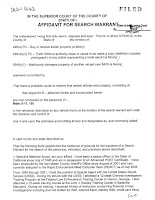
Tampa Technology Lawyer and Criminal Defense Expert, W.F. ”Casey” Ebsary, Jr. in Florida has spent time reviewing a rather interesting Search Warrant for a cellular telephone. Specifically, an iPhone that Apple Computer Corporation wanted to retrieve. Take a look at the 22 page warrant and what was seized for yourself: Cell phones, text messages, and email are a frequent target of state and federal law enforcement when investigating technology cases.


Search Warrant for a Cell Phone? Tell Your Story Toll Free 813-222-2220.

Federal Prosecutor's Discovery Procedural Memo

AUSA, DOJ, United States Attorney, Memo

United States Attorney Memo


Tampa Federal Criminal Defense Attorney Casey Ebsary has obtained a copy of a recent memo to  United States Department of Justice / Assistant United States Attorneys on Procedures they are to follow in prosecuting federal crimes in Federal Court, including the Middle District of Florida.


MEMORANDUM FOR DEPARTMENT PROSECUTORS

 The discovery obligations of federal prosecutors are generally established by Federal Rules of Criminal Procedure 16 and 26.2, 18 U.S.C. §3500 (the Jencks Act), Brady v. Maryland, 373 U.S. 83 (1963), and Giglio v. United States, 405 U.S. 150 (1972). In addition, the United States Attorney’s Manual describes the Department’s policy for disclosure of exculpatory and impeachment information. See USAM §9- 5.001. In order to meet discovery obligations in a given case, Federal prosecutors must be familiar with these authorities and with the judicial interpretations and local rules that discuss or address the application of these authorities to particular facts. In addition, it is important for prosecutors to consider thoroughly how to meet their discovery obligations in each case. Toward that end, the Department has adopted the guidance for prosecutors regarding criminal discovery set forth below. The guidance is intended to establish a methodical approach to consideration of discovery obligations that prosecutors should follow in every case to avoid lapses that can result in consequences adverse to the Department’s pursuit of justice. The guidance is subject to legal precedent, court orders, and local rules. It provides prospective guidance only and is not intended to have the force of law or to create or confer any rights, privileges, or benefits. See United States v. Caceres, 440 U.S. 741 (1979).

Source: The complete Memorandum can be found at https://www.justice.gov/dag/discovery-guidance.html


Federal Prosecutor’s Discovery Procedural Memo | Tampa Federal Criminal Defense Attorney

Confession Tossed | Promises of Immunity

“promises of non-prosecution / immunity prevented the defendant from making a voluntary, knowing, and intelligent waiver of his Miranda rights”

Federal Defense Attorney in Florida Miranda, Confession, Immunity

Confessions, Immunity, and Miranda


Confessions, Immunity, and Miranda


Federal Defense Attorney in Florida got a great tip from our friends at the Federal Defenders in Tampa and Orlando. New case involved a State agent / detective who promised a defendant he would not be prosecuted. Then he told the Feds about the evidence he gathered from the defendant. Federal Prosecutors use the evidence and the Secret Service busts him. The Eleventh Circuit held that a State Policeman’s promises of non-prosecution / immunity prevented the defendant from making a voluntary, knowing, and intelligent waiver of his Miranda rights.


The Court also held that, even if, the defendant had not been in custody at the time of the confession (making Miranda warnings unnecessary) the confession was involuntary under the Due Process Clause. The only interpretation of the State detective’s representations was that the information the defendant provided would not be used against him by state cops, feds, or anyone else. Circumstances of the defendant’s statements were enough to render his confession involuntary.


The Court rejected the Fed’s  argument that the state detective’s promise of non-prosecution did not bind the Feds and the United States Government. The Eleventh Circuit held that an involuntary confession is inadmissible in federal prosecutions even if improperly coerced by state police. See: Murphy v. Waterfront Commission of New York Harbor, 378 U.S. 52 (1964). The Court also required the suppression of the physical evidence seized as the fruit of the coerced confession.

Source: Fed Defender MD Fla and https://www.ca11.uscourts.gov/opinions/ops/200910794.pdf


Federal Defense Attorney in Florida

Federal Defense Attorney on Search and Seizure of Electronic Devices

Search Warrant, Tampa criminal defense attorney, Tampa Criminal Defense Lawyer, Tampa Federal Criminal Defense Lawyer, Tampa Federal Criminal Defense Attorney Tampa Federal Criminal Defense Lawyer

Search Warrant

Tampa Federal Criminal Defense Attorney has reviewed Government policies on Search and Seizure of Electronic Devices at borders. The U.S. Department of Homeland Security’s (DHS) policy is to treat computers, laptops, and other electronic devices like suitcases and backpacks in terms of border searches. It appears under current DHS policy, Customs and Border Protection (CBP) agents believe they are not required to provide justification or a reason for these electronic searches.


In a response to a recent Freedom of Information Act (FOIA) request, CBP disclosed the following: Electronic devices that were searched included laptops, USB thumb drives, hard drives, cell phones, digital cameras, and even DVD disks . From October 2008 through June 2009, CBP officials searched over 1,500 electronic devices belonging to travelers.


Cell phones were the most often searched and seized devices between October 2008 and June 2009. From July 2008 to June 2009, and Border Protection (CBP) transferred electronic files found on travelers’ devices to third-party agencies almost 300 times. More than 80 percent of the transfers involved the CBP making copies of travelers’ files. Over half the time, these unknown agencies asserted independent bases for retaining or seizing the transferred files.


As a defense attorney, it appears that the best strategy when traveling is to leave electronic devices at home.


Search Warrant, Tampa criminal defense attorney, Tampa Criminal Defense Lawyer, Tampa Federal Criminal Defense Lawyer, Tampa Federal Criminal Defense Attorney Tampa Federal Criminal Defense Lawyer

Border Search?
Tell Me Your Story Toll Free 1-877-793-9290.
 

Sources: https://www.informationweek.com/news/
government/security/showArticle.jhtml?articleID=219500468
https://www.nefafoundation.org/miscellaneous/
FeaturedDocs/DHS_ForeignTravelThreatAssessment.pdf
https://www.aclu.org/print/national-security/customs-and-border
-protection-cbp-first-production-documents

Federal Defense Attorney on Search and Seizure of Electronic Devices

Text and Email Messages at Work

Search Warrant Text Messages Tampa Florida Attorney Lawyer

Search Warrant Text Messages


“law prohibits providers from providing the contents of any

communication that is maintained on the service without a search warrant”


Up until this week a Florida Attorney would tell you that your employer can probably read your emails and text messages on company provided devices. That may change based on a recent development in an appeals court’s decision. In that case, the court found your boss shouldn’t read your text or e-mail messages.

Text messages were obtained from a wireless carrier and reviewed by an employer without the employee’s permission. The federal appeals court sharply limited the ability of employers to obtain e-mails and text messages sent by employees on company accounts.

A Tampa Internet lawyer observes that Access to e-mail could be barred if the employer contracts out its e-mail service rather than maintaining an internal server to handle it.

One report found that about 28% of Microsoft Outlook users have their e-mail handled by an outside vendor, according to research firm Radicati Group. The ruling also gave government workers Fourth 4th Amendment protection against searches of text and e-mail communications by their bosses.

The privacy case was a unanimous ruling and the first federal appellate decision to provide 4th Amendment protection to electronic messages. Arguably, police may now need to obtain a warrant before they could access someone’s e-mail or text messages.

The court found that the wireless service provider violated the Federal Stored Communications Act. That law prohibits providers from providing the contents of any communication that is maintained on the service without a search warrant.


Employees had an expectation of privacy that was protected by the Constitution. Feel free to contact Board Certified Trial Lawyer, W.F. ”Casey” Ebsary Jr. Toll Free at 1-877-793-9290 to discuss how this may affect you.

Search Warrant Text Messages 

Federal Sentencing in Computer Related Crimes

crimes computer Tampa Florida Computer Crimes Attorney/Lawyer

For More Computer Crimes Info

Tampa Florida Federal Criminal Defense Attorney, Lawyer W.F. ”Casey” Ebsary notes that Computer crimes draw stiff sentences in Federal Courts. However, at a United States Sentencing Commission (USSC) hearing in Chicago, a Judge said it would give him comfort in affirming below-guideline sentences in child porn cases to see data showing there are lots of below guidelines sentences. There is such data.

In the first three quarters of 2009, judges sentenced below the guideline range in 503 of 1195 cases (42%) and the government moved for a below-guideline sentence in another 128 cases (10.7%), 101 of which were for reasons other than 5K1.1, that is, for reasons under 3553(a). See USSC Preliminary Data Report, Table 5.

The complete Report is at the link below:

If you have a computer problem in Federal or State Court – Tell Me Your Story Toll Free 1-877-793-9290.

Source: https://www.ussc.gov/sc_cases/USSC_2009_Quarter_Report_3rd.pdf.

White Collar Sentencing in Federal Court

Tampa Federal Criminal Defense Attorney, Lawyer

White Collar Sentencing in Federal Court Crackdown

White Collar Sentencing in Federal Court Crackdown noted by Tampa Federal Criminal Defense Attorney, W.F. ”Casey” Ebsary, Jr. – The Eleventh Circuit Court declared a sentence illegal when a white collar defendant was not sent to prison. The trial court has repeatedly placed the defendant on the federal equivalent of probation. The United States Attorney has repeatedly appealed the below guidelines sentence, and the appeals court has repeatedly reversed.


The court concluded “it is difficult to imagine a would-be white-collar criminal being deterred from stealing millions of dollars from his company by the threat of a purely probationary sentence, regardless of how much probation that person received.”

The complete decision is available here:

Opinion of the Appeals Court

White Collar Financial Fraud Defense? Tell Me Your Story Toll Free 1-877-793-9290 .

Note: This office did not represent any parties in this case.

Source: https://www.ca11.uscourts.gov/opinions/ops/200814712.pdf

White Collar Sentencing in Federal Court

Junk Science and Federal Criminal Defense

Junk Scirnce

Junk Science


Junk Science


Florida Federal Criminal Defense Attorney, W.F. ”Casey” Ebsary, Jr. just returned from a great seminar on fighting the admissibility of Junk Science in federal criminal cases.


To attack Junk Scientific Evidence, one must look beyond the practitioners of the field itself. State of Maryland v. Bryan Rose, K06-0545 (Cir. Balt. Co. 2008) (“general acceptance of latent print identification by its practitioners does not constitute general acceptance by the ‘scientific community’ . . .”); United States v. Saelee, 162 F.Supp.2d 1097 (“Finally, the evidence does indicate that there is general acceptance of the theories and techniques involved in the field of handwriting analysis among the closed universe of forensic document examiners. This proves nothing.”). In most cases, the Government has not and will not be able to produce anyone beyond law enforcement technicians.

The seminar was available for free here: Junk Science in Federal Courts https://centrallaw.com/JunkScienceInFederalCourt_files/frame.htm


Thanks to Attorney Frank Godbold.

Computer Search Warrants

Computer Search Warrants,

Computer Search Warrants


“Government cannot rely on the Fourth Amendment’s plain-view doctrine in cases where the investigators rely on the intermingling of computerized records”


Computer Search Warrants


Tampa Criminal Defense Attorney reports severe limits in  Computer Search Warrants and Searches – Another court has laid out detailed procedures for issuance and execution of search warrants for computers that contain files outside the scope of a search warrant. The court ruled that the Government cannot rely on the Fourth Amendment’s plain-view doctrine in cases where the investigators rely on the intermingling of computerized records to justify a broad seizure and examination of electronically stored records. United States v.Comprehensive Drug Testing Inc., 9th Cir.(en banc), No. 05-10067 (8/26/09).


The court states, “The process of segregating electronic data that is seizable from that which is not must not become a vehicle for the government to gain access to data which it has no probable cause to collect.” The plain-view doctrine is an issue courts have been struggling with.


Detailed procedures for searches of computer electronic data:

1. The government must not rely on the plain view doctrine in digital evidence cases.
2. Search must be either done by specialized personnel with a procedure to prevent disclosure investigators of information that is not the target of the warrant.

3. The government’s search method must be designed to uncover only the information for which it has probable cause.


When Computers Land in Court, We Can Help – Tell Me Your Story Toll Free  – 1-877-793-9290.


Source: https://pub.bna.com/cl/0510067a.pdf

Computer Search Warrant Tampa – Overbroad


Tampa Federal Criminal Defense Attorney Lawyer - Computer Search Warrant

Computer Search Warrant

Tampa Federal Criminal Defense Attorney, Lawyer W.F. ”Casey” Ebsary, Jr. , noted a recent case decided on the scope of search warrants issued in computer cases. Wired magazine noted:

“A divided 11-judge federal appeals court panel has dramatically narrowed the government’s search-and-seizure powers in the digital age, ruling Wednesday that federal prosecutors went too far when seizing 104 professional baseball players’ drug results when they had a warrant for just 10.”

The Court suggested that during a computer’s hard drive search, data should be culled to include the specific data described in the search warrant. The entire hard drive should not be subject to a wholesale review. When the entire drive is seized, an independent third party should review the data. The information should be limited by the Court. The term “filter teams” has been used to refer to the third party who review data seized by a search warrant.

The Appeals Court stated that the judge reviewing the search warrant application should “deny the warrant altogether” if the government does not agree to a third-party review in cases where data will be searched.

Has your data been the subject of a Search Warrant? We can help. Call Toll Free 1-877-793-9290 .

Source: wired.com/threatlevel/2009/08/privacyboost/

Computer Search Warrant Tampa – Overbroad